# Week 4 - Support Vector Machines
Last edited: 2024-01-29
# Linearly separable
We are going to revisit the idea of linearly separable points in the plane.
Suppose we have training data $(x^t, y^t) \in \mathbb{R}^n \times \{1,-1\}$ for $t \in T$ such that $X_1 = \{x^t \vert y^t = 1\}$ and $X_2 = \{x^t \vert y^t = -1\}$ are linearly separable. This means that there exists some $w \in \mathbb{R}^n$ and $b \in \mathbb{R}$ such that
$$ y_t ( x^t \cdot w + b ) = y_t \left ( \sum_{i=1}^n x^t_i w_i + b \right ) \geq 0 $$for every $t \in T$.
Geometrically $w$ and $b$ represent a hyperplane defined by $w$ being the tangent vector and $bw$ being a point on the hyperplane .
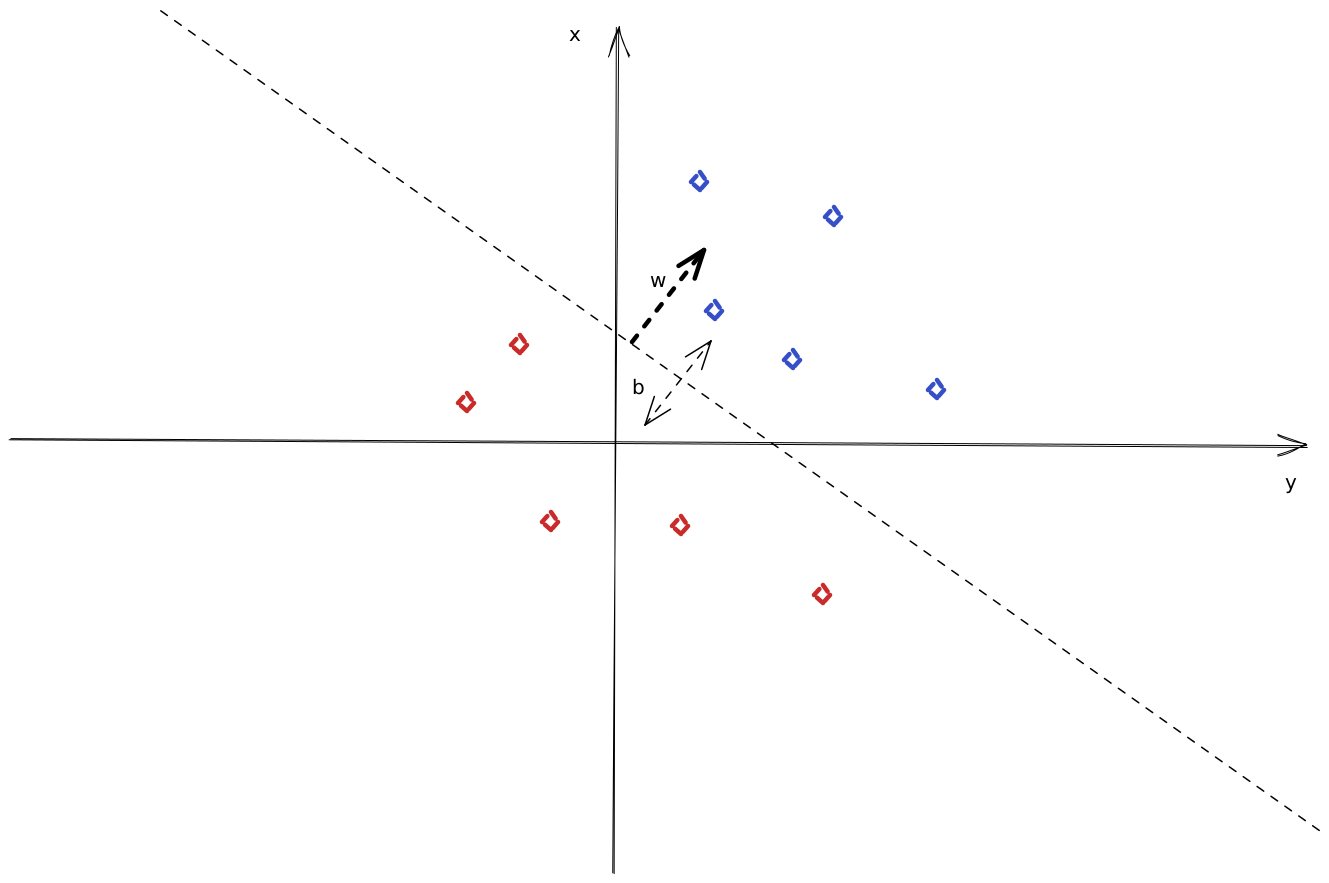
When defining a hyperplane you always have a choice of tangent vector both in scaler (we will come back to that later) and direction. The direction of $w$ dictates which side of the hyperplane is “positive”,
- if $w = (1,0)$ with $b=0$ then the point $(2,3)$ lies on the “positive” side as $1 \cdot 2 + 0 \cdot 3 + 0 = 2$, whereas
- if $w = (-1,0)$ with $b=0$ then the point $(2,3)$ lies on the “negative” side as $-1 \cdot 2 + 0 \cdot 3 + 0 = -2$.
# Best separator
When you have some points that are linearly separable there might be many choices of $w$ and $b$. Though which one is the best? And what does the best mean?
Ideally we would want to choose a line that:
- Linearly separates the points, whilst
- maximising the minimum distance between the points and the line.
The intuition as to why we would want this is by making our separating line the furthest away from the points it can be whilst still separating them means we are trying to avoid overfitting the best we can. The line is as far away from our training data as it possibly can be.
# Margin
Suppose we have a linear separator defined by $w$ and $b$. Once again set $X_1 = \{x^t \vert y^t = 1\}$ and $X_2 = \{x^t \vert y^t = -1\}$ for our training data $T$. It is useful to have a concept for the minimum distance from a point in $X_1 \cup X_2$ to the hyperplane $H = (w, b)$.
# Calculating the best $w$ and $b$
Let $x_1 \in X_1$ and $x_2 \in X_2$ be the points such that
$$ x_1 \cdot w + b = \min_{x \in X_1} x \cdot w + b, \mbox{ and } \ x_2 \cdot w + b = \max_{x \in X_2} x \cdot w + b $$i.e. these are the positive and negative points that are closest to the line. If we have chosen $b$ optimally we would have that
$$ x_1 \cdot w + b = - \left ( x_2 \cdot w + b \right). $$The distance between the hyperplanes defined by $H_1 = (x_1, w)$ and $H_2 = (x_2, w)$ is given by
$$ x_1 \cdot \frac{w}{\vert \vert w \vert \vert} - x_2 \cdot \frac{w}{\vert \vert w \vert \vert} = \frac{(x_1 - x_2) \cdot w}{\vert \vert w \vert \vert}. $$This gives the margin to be
$$\rho = \frac{(x_1 - x_2) \cdot w}{2 \vert \vert w \vert \vert}.$$So to pick the best $w$ and $b$ we will need to maximise $\rho$. However notice we can always scale $w$ so that
$$ x_1 \cdot w + b = - \left ( x_2 \cdot w + b \right) = 1. $$Therefore if we make the linearly separable constraint that
$$ y^t \left ( \sum_{i=1}^n x^t_i w_i + b \right ) \geq 1 $$to maximise $\rho$ is the same as
$$ \max \frac{(x_1 - x_2) \cdot w}{2 \vert \vert w \vert \vert} = \max \frac{(x_1 \cdot w + b) - (x_2 \cdot w + b))}{2 \vert \vert w \vert \vert} = \max \frac{1}{\vert \vert w \vert \vert}. $$Therefore we now have an optimisation problem.
For linearly separable $(x^t, y^t) \in \mathbb{R}^n \times \{-1,1\}$ find $w \in \mathbb{R}^n$ and $b \in \mathbb{R}$ where $\max_{w, b} \frac{1}{\vert \vert w \vert \vert}$ such that
$$ y^t \left ( \sum_{i=1}^n x^t_i w_i + b \right ) \geq 1, \mbox{ for all } t \in T. $$Training points $x^t$ where
$$\vert w \cdot x^t \vert = 1$$are called support vectors. As they constrain the hyperplane $(w, b)$.
# Back to reality
Our training data is nearly never linearly separable so how can we adapt what we have to handle this?
Instead of enforcing
$$ y^t \left ( \sum_{i=1}^n x^t_i w_i + b \right ) \geq 1, \mbox{ for all } t \in T. $$we allow some error $\zeta_t$ and we want to minimise it.
For training data $(x^t, y^t) \in \mathbb{R}^n \times \{-1,1\}$ find $w \in \mathbb{R}^n$ and $b \in \mathbb{R}$ where
$$\min_{w, b, \zeta} \frac{1}{2}\vert \vert w \vert \vert^2 + C \sum_{t \in T} \zeta_t$$such that
$$ y^t \left ( \sum_{i=1}^n x^t_i w_i + b \right ) \geq 1 - \zeta_t \ \mbox{ and } \zeta_t \geq 0, \mbox{ for all } t \in T. $$We transformed the maximisation problem of $\frac{1}{\vert \vert W \vert \vert}$ to a minimisation of $\frac{1}{2} \vert \vert w \vert \vert^2$. I don’t really know why they add the half, I think they square it to get rid of the square root in the modulus.
We have added a trade off parameter $C \in \mathbb{R}$ do we care more about a tight fit or a lower error term.
# Here comes the magic
This is apparently a quadratic programming problem and can be transformed to the “Dual Optimization Problem” which is as follows
$$ \max_{\alpha} \sum_{t \in T} \alpha_t - \frac{1}{2} \sum_{t,s \in T} \alpha_t \alpha_s y^t y^s (x^t \cdot x^s)$$such that
$$ \alpha_t \geq 0 \mbox{ for all } t \in T, \mbox{ and } \sum_{t \in T} \alpha_ty^t = 0.$$Which we turn this into a classifier by setting:
$$ \hat{f}(x) = \mbox{sgn}\left ( \sum_{t \in T} \alpha_t y^t (x^t \cdot x) + b \right )$$where
$$ b = y^s - \sum_{t \in T} \alpha_t y^t (x^t \cdot x^s), \mbox{ for any } s \in T \mbox{ such that } \alpha^s \not = 0. $$The form should remind you of Boosting where we take an average of lots of different views on the data. However in reality lots of these $\alpha_t = 0$ if they are not the support vectors closest to the line. So it might be more correct to think of this as close to KNN .
# Handling very not separable data
In reality data could be far from linearly separable. For example for xor we have the following embedding in $\mathbb{R}^2$ of the 4 training points
$$\{((1,1), -1), ((1,-1), 1), ((-1,-1), -1), ((-1,1), 1)\}.$$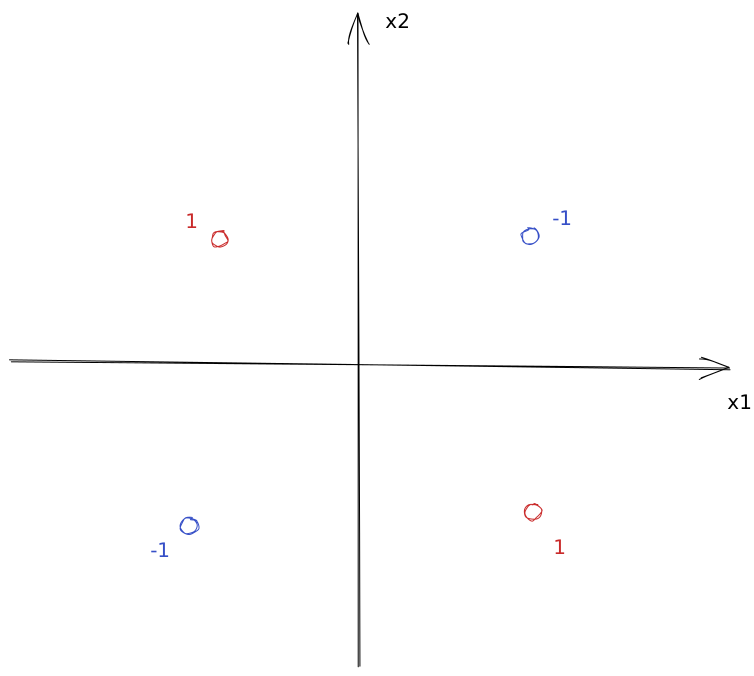
This is far from linearly separable. However, we can define a new embedding mapping
$$K: \mathbb{R}^2 \rightarrow \mathbb{R}^6, \ \mbox{ by } \ (x_1, x_2) \mapsto (x_1^2, x_2^2, \sqrt{2} x_1x_2, \sqrt{2} x_1, \sqrt{2} x_2, 1)$$which when applied to the domain of our training data rearranges our points to be
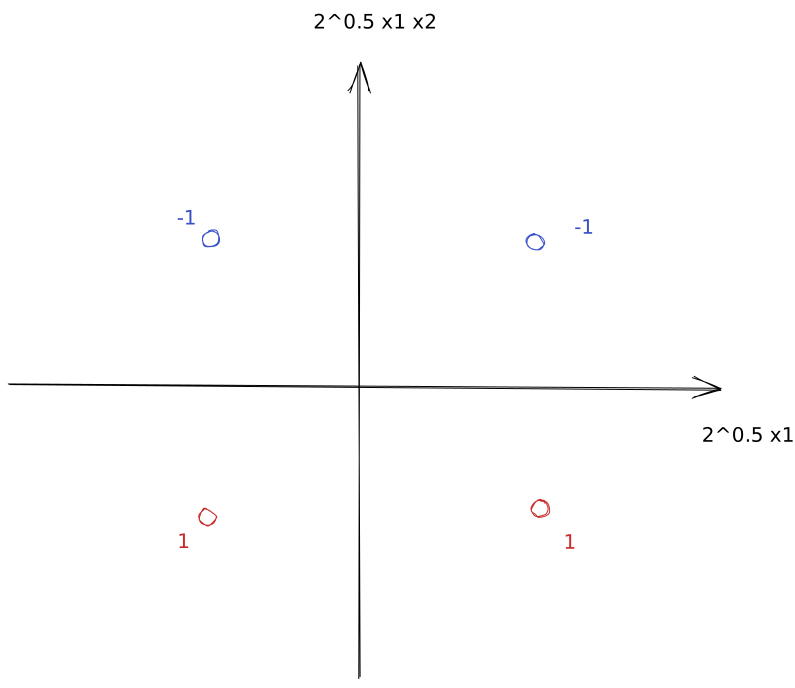
which are easily linearly separable .
Though how do we choose these embeddings?
# Kernel methods
There are some popular kernels to try.
# Support Vector Machines
We are now going to take the idea of the kernel trick where we embed our feature space $A$ using $\Phi$ into a space in which our dataset is closer to linearly separable . This turns our optimisation problem from before into
$$ \max_{\alpha} \sum_{t \in T} \alpha_t - \frac{1}{2} \sum_{t,s \in T} \alpha_t \alpha_s y^t y^s (\Phi(x^t) \cdot \Phi(x^s))$$such that
$$ \alpha_t \geq 0 \mbox{ for all } t \in T, \mbox{ and } \sum_{t \in T} \alpha_ty^t = 0.$$Which we turn this into a classifier by setting:
$$ \hat{f}(x) = \mbox{sgn}\left ( \sum_{t \in T} \alpha_t y^t (\Phi(x^t) \cdot \Phi(x)) + b^t \right )$$where
$$ b^s = y^s - \sum_{t \in T} \alpha_t y^t (\Phi(x^t) \cdot \Phi(x^s)), \mbox{ for any } s \in T \mbox{ such that } \alpha^s \not = 0. $$However, we only have use $\Phi$ on two vectors who immediately get the dot product applied to them - so we can replace this with the kernel instead.
# Why doesn’t Boosting have as many problems with Overfitting
In practice when using Boosting we tend to find the training error and testing error follow each other, rather than separate as in the case with overfitting . This is connected to SVMs by the concept of margins . When we talked about SVMs we stated that a larger margin was better as it reduced the overfitting . The margin is analogous to the confidence level we have in our model.
In relation to Boosting we can think of the algorithm as a complicated way of projecting $\Phi: A \rightarrow \mathbb{R}$ before taking the sign of the value to determine our prediction. As we train for a longer period of time we separate data points more and more - increasing the margin and thus our confidence in the outcomes. This counter intuitively reduces overfitting in a lot of cases.
This does not hold for all Boosting for example if we use this with Neural networks it will still be liable to overfit .