# Week 1 - Decision Trees
Last edited: 2024-01-10
Supervised learning
Supervised learning falls into two main problems sets
Classification problems - Mapping from a domain to some discrete set, and Regression problems - mapping from a domain to some continuous space like the Real numbers ($\mathbb{R}$).
For example, making a decision on whether you should give someone a loan is a classification problem as there are only two outcomes - whereas mapping from someone’s picture to their age would be a regression problem.
Classification
First lets start by defining terms used in this course.
- Instance - an input,
- Concept - the function from inputs to outputs,
- for example a car is simply a mapping from things in the world to True or False based on if that is a car or not.
- Target concept - the ideal answer or optimal concept.
- Hypothesis class - This is the set of all concepts we want to consider
- This might be smaller than the set of all concepts.
- Sample / Training set - A set of labelled data i.e. a pair (input, output)
- Candidate - the current concept under investigation.
- Testing set - A set of labelled data that will be used to evaluate your candidate
- It is important it is distinct from the training set.
# My mathematical interpretation
Suppose we have two sets $A$ and $B$ and we are looking to find some function optimal function $f^{\ast}: A \rightarrow B$.
- Instance - some element $a \in A$.
- Concept - a function $f: A \rightarrow B$.
- Target concept - the function $f^{\ast}$.
- Hypothesis class - a restricted class $C \subset Func(A,B)$ that we will consider.
- This restriction may be applied due to the set of algorithms you are considering.
- Sample / Training set - A set $T \subset A \times B$ of observations.
- Ideally $T \subset \{(a,f^{\ast}(a)) \vert a \in A\}$ however this might not be possible.
- Candidate - a function $f': A \rightarrow B$ which is our current guess at $f^{\ast}$.
- Testing set - A set $E \subset A \times B$ similar to training set but with intent to test the current candidate on.
Decision trees
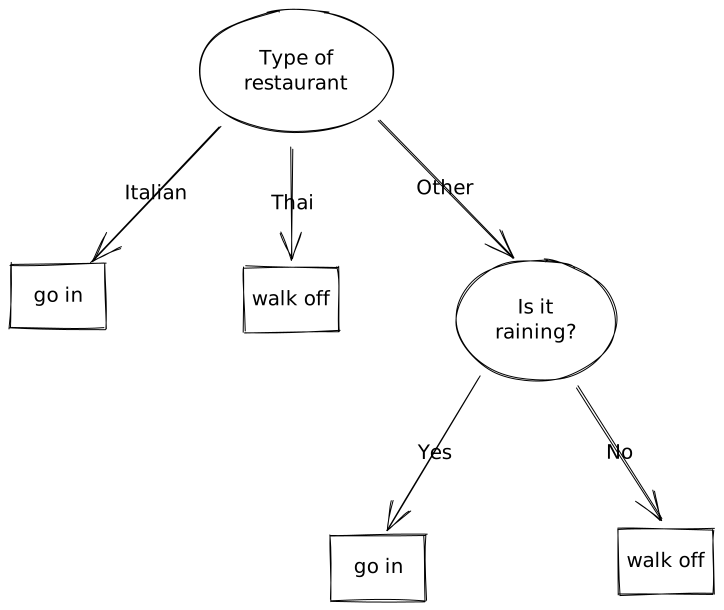
Suppose your domain $A$ actually breaks down into many different aspects $A = \oplus_{i=1}^k A_i$. Like if you were making a decision about whether to go into the restaurant your aspects could be the type of restaurant, whether it is raining, and how full the restaurant is.
Then a Decision tree is a rooted tree where
- Each parent node is affiliated with an aspect with each child branch being affiliated with a collection of potential values. We make sure all potential values of that aspect are covered by the branches.
- Each child node is associated to a value in the codomain $B$.
An example for the problem of restaurant choosing is below.
# Boolean decision trees
Suppose our domain consists of $A_i = \{T, F\}$ Boolean’s , either true or false as well as our codomain $B = \{T, F\}$. Then our function $f^{\ast}$ represented by the decision trees is a boolean function .
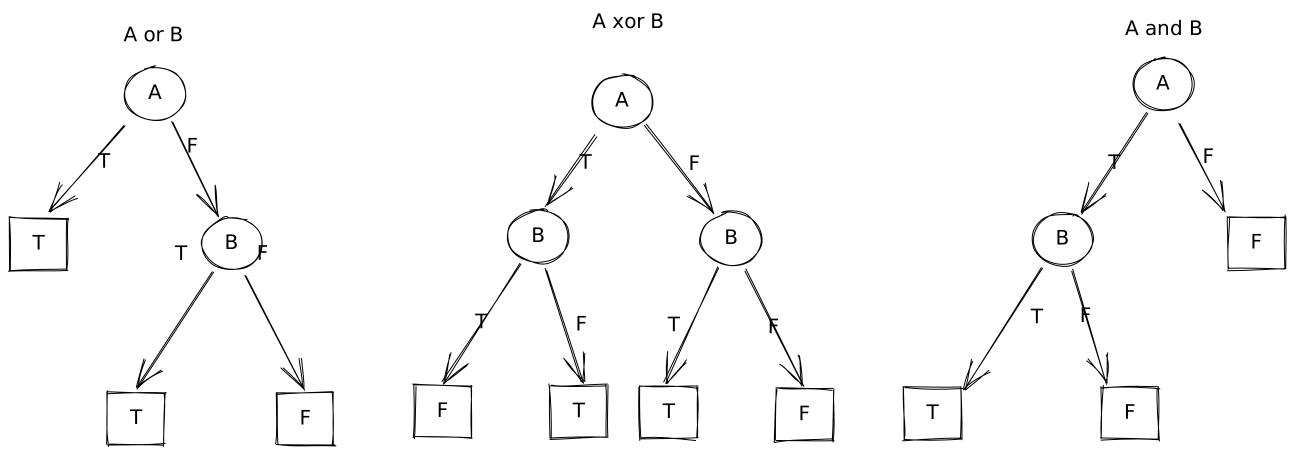
These can expand to many variables, and for different functions can grow with different rates.
- Logical or and Logical and with $n$ variables uses $O(n)$ nodes.
- Even/odd parity (true if an even/odd number of inputs are True) with $n$ variables uses $O(2^n)$ nodes.
ID3
Iterative Dichotomiser 3 (ID3)
Bias
In ID3 the restriction bias comes from the fact that the have a decision tree based on a set of attributes.
For example, if you let the attributes $T = Func(A,B)$ then the decision tree can represent any function in $Func(A,B)$ trivially. Though this might be computationally completely infeasible in most cases!
Whereas the preference bias comes from the ID3 algorithm itself:
- good splits near the root of the tree,
- ones that lower the entropy more, and
- shorter trees.
Other considerations
# Continuous variables
Suppose we have some continuous attribute in $A$. Whilst we could have a branch for every value that attribute could take, it is most probably best to categorify the value by their picking Boolean decisions like is it $\geq a$ or $< a$ for $a \in A$ or splitting the value into ranges.
# Pruning
The model can have overfitting if the tree gets too large. Therefore it is good practice to contract (or prune) branches of the tree if they have marginal effect on the outcome of the decision tree . This splits into two subcategories pre-pruning and post-pruning.
# Pre-pruning decision trees
# Post-pruning decision trees
Post-pruning is the process of letting the tree organically grown. Then evaluating if the branches are worth keeping or they overfit the data.
Due to the
# Regression problems
It is possible to tackle this with a decision tree if you only care about approximate answer. However, you will have to change the definition of information entropy to work in the continuous space. This will have to use something like an average of the leaf nodes.
# Gini Index
Above we used Information entropy to choose which feature to split along. However there are other options like the Gini index .