# Week 13 - Game theory
Last edited: 2024-04-06
# 2-player zero-sum finite game of perfect information
This is a lot of words but these games are like tick tack toe or noughts and crosses. Whilst these are fun they all boil down to a payoff matrix for the different strategies you take. Like the following
$$ \begin{array}{c|ccc} \ 1 & a & b & c\\ \hline x & 1 & 0 & -1 \\ y & -1 & 0 & 1 \\ \end{array} $$to read this table, if the first player at the top picks action $a$ and the second player on the rows picks $x$ then player one gets 1 point whereas player two gets -1 point. This is the zero-sum aspect to the game. (Note the game could be non-deterministic but we just take expectation to find the values in the grid.)
We call the options $a$, $b$, $c$, $x$ and $y$ strategies.
Optimum play exists for 2-player zero-sum games with perfect information
This means we can determine the value of the game by both players following their best strategy we can work out the value of the game.
I don’t really understand what happens in the case
$$ > \begin{array}{c|cc} > \ 1 & a & b \\ \hline > x & 1 & -1 \\ > y & -1 & 1 \\ > \end{array} > $$What would be the optimal pure strategy?
# No more perfect information
Perfect information means that all the knowledge is known by all players at the start of the game. A good example where this is not the case is poker.
Suppose we are in a game where the following happens:
- Player one is dealt a card, 50% of the time it is red and the other 50% it is black.
- If player one is dealt a black card they can resign or keep playing. If they are dealt a red card they have to keep playing. If they resign they get -20 score.
- Player two then gets to choose to resign or for player one to show them their card.
- If player two resigns player one gets 10 points.
- If player one shows their card and it is back they get -40 points.
- If player one shows their card and it is red they get 30 points.
What is the optimum play for either party?
In this case we can still calculate the payoff matrix. Note if player one chooses a resign strategy by they get dealt a red card they have to keep going.
$$ \begin{array}{c|cc} \ \mbox{red} & \mbox{resign} & \mbox{hold}\\ \hline \mbox{resign} & -20 & 10 \\ \mbox{show} & -20 & -40\\ \end{array} \ \ \ \ \ \begin{array}{c|cc} \ \mbox{black} & \mbox{resign} & \mbox{hold}\\ \hline \mbox{resign} & 10 & 10 \\ \mbox{show} & 30 & 30\\ \end{array} \ \ \ \ \ \begin{array}{c|cc} \ \mbox{either} & \mbox{resign} & \mbox{hold}\\ \hline \mbox{resign} & -5 & 10 \\ \mbox{show} & 5 & -5\\ \end{array} $$I don’t really get how this situation is any different to the above ones. The lecturers say now the value of the game differ for both players but it still boils down to a matrix that you could have gotten with a normal game?
# Mix strategies
However you can have non-deterministic strategies.
In the game above, if player one holds with probability $p$ then we get expected return $15p- 5$ if player two resigns otherwise we get $5 - 10p$ profit if player two sees the card. Therefore if we choose $p = 0.4$ we can get expected profit of $1$ no matter what player $B$ does.
If you do the same for player two, picking to see with probability $q$ then we get expected return $10q - 5$ if player one resigns but $10 - 15q$ if they hold. Then we get optimum $q = 3/5$ which also gives player one a profit of 1.
# Removing zero-sum
In the Prisoner’s dilemma the dominating strategy is for them both to testify. Even if any player could change their decision after finding out the outcome they wouldn’t want to.
This works for both pure or mixed strategies.
# Dominating strategies
This could be used to get Nash equilibrium .
Elimination and Nash Equilibrium
Though this doesn’t guarantee finding it. Though there is always a Nash equilibrium in finite games.
Normally the best way to get out of the prisoners dilemma is to change the structure of the game.
# Multiple rounds
Suppose now you are in a situation where you are playing iterative rounds of a game with the same player.
# Known number of rounds
One approach to solving this issue is to combine possible series of strategies as a new series and to investigate the composite game. Though an easier solution to this situation can be found be thinking of them separately.
If the number of rounds are known beforehand, then consider the last round. As there are no games afterwards - there is no incentive to not behave rationally, so we will use the Nash equilibrium strategy.
Though given this last game is already decided we might as well consider playing one less game. Though this inductively gives that each player will play a Nash equilibrium strategy at each step of the game.
However, which Nash equilibrium is an interesting problem!
# Unknown number of rounds
At the end of a round suppose there is a $\gamma$ chance you play again and a $1-\gamma$ chance you end. This stays constant and you use discounted rewards to evaluate performance.
Discounted rewards is perfectly built for this. Suppose $G$ is the random variable for the value of playing this game, let $g_i$ be the reward for the $i'th$ round then
$$\mathbb{E}[G] = g_i + \gamma \mathbb{E}[G] + (1-\gamma) 0 = g_i + \gamma \mathbb{E}[G].$$Therefore if we pick a strategy that would pay off $g_i$ in round $i$ if it were played then the total expected value of this strategy would be
$$\mathbb{E}[G] = \sum_{i \in \mathbb{N}} g_i \gamma^i.$$The expected number of round in this set up is $\frac{1}{1-\gamma}$.
# Tit for Tat
When in the above situation there are some meta strategies you can adopt. For example you can always choose one option - like in the known number of rounds example. However, you can now adopt strategies that depend on the opponents move.
Suppose we do this with the prisoners dilemma. Now lets consider 4 strategies, always stay silent (silent), always testify (testify) or tit for tat (tft) where you start silent or testify. Lets consider the strategy matrix (to simplify things I took a factor of $\frac{1}{1 - \gamma}$ out)
$$ > \begin{array}{c|cc} > \ \mbox{A \\ B} & \mbox{silent} & \mbox{testify} & \mbox{tft-silent} & \mbox{tft-testify}\\ \hline > \mbox{silent} & (1,1) & (3,0) & (1,1) & (3-2\gamma, \gamma) \\ > \mbox{testify} & (0,3) & (2,2) & (2 \gamma, 3 - \gamma) & (2,2) \\ > \mbox{tft-silent} & (1,1) & (3 - \gamma, 2 \gamma) & (1,1) & (\frac{3}{1 + \gamma}, \frac{3 \gamma}{1 + \gamma})\\ > \mbox{tft-testify} & (\gamma, 3-2\gamma) & (2,2) & (\frac{3\gamma}{1+\gamma}, \frac{3}{1 + \gamma}) & (2,2)\\ > \end{array} > $$Lets consider the preferred strategy when your opponent has already picked (this depends on $\gamma$).
| Opponent | $\gamma < 0.5$ | $\gamma = 0.5$ | $\gamma > 0.5$ |
|---|---|---|---|
| Silent | Testify | Testify | Testify |
| Testify | Testify, tft-testify | Testify, tft-testify | Testify, tft-testify |
| tft-silent | testify | Any | tft-silent, silent |
| tft-testify | Testify, tft-testify | Any | silent |
Here no matter what $\gamma$ we have that testify is a Nash equilibrium . Though we have additional equilibrium depending on $\gamma$
- for $\gamma \leq 0.5$ tft-testify is also a Nash equilibrium , and
- for $\gamma \geq 0.5$ tft-silent is also a Nash equilibrium .
# Picturing Mixed strategies for repeated games
Now we are repeating games we could adopt a Mixed strategy of meta strategies. i.e. decide a probability distribution over the strategies and use them dependent on a random variable.
To calculate the Minmax profile of the Battle of the sexes we have to think about how one player could punish the other player the most. (This game is simpler as it is symmetric.) Using a Pure strategy if $B$ wanted to punish $A$ they would go for $y$ and so the best $A$ could do would be 1 point.
However, this is not the worst player $B$ could do. Instead they use a mixed strategy and went to $x$ with probability $p$ and $y$ with probability $(1-p)$. Then player $A$ choosing $x$ would give them $2p$ whereas choosing $y$ gives them $(1 - p)$. Which setting $p = 1/3$ gives the expected return of either decision to be $2/3$.
This gives the following Minmax profile .
$$ \begin{array}{c|c} \ \mbox{A} & \mbox{B} \\ \hline \frac{2}{3} & \frac{2}{3} \\ \end{array} $$
# Feasible region
In the Battle of the sexes we saw that one player could in expectation guarantee another player a lower score by adopting a mixed strategy. Therefore they have made the pay off a point that isn’t in $\{(0,0), (2,1), (1,2)\}$. So what is the feasible region of expected scores using mixed strategies ?
If player $A$ picks $x$ with probability $p$ and player $B$ picks $x$ with probability $q$ then we get the expected score
$$(pq2 + (1-p)(1-q), pq + 2(1-p)(1-q)).$$This gives us all the points in the convex hull of the points $\{(0,0), (2,1), (1,2)\}$.
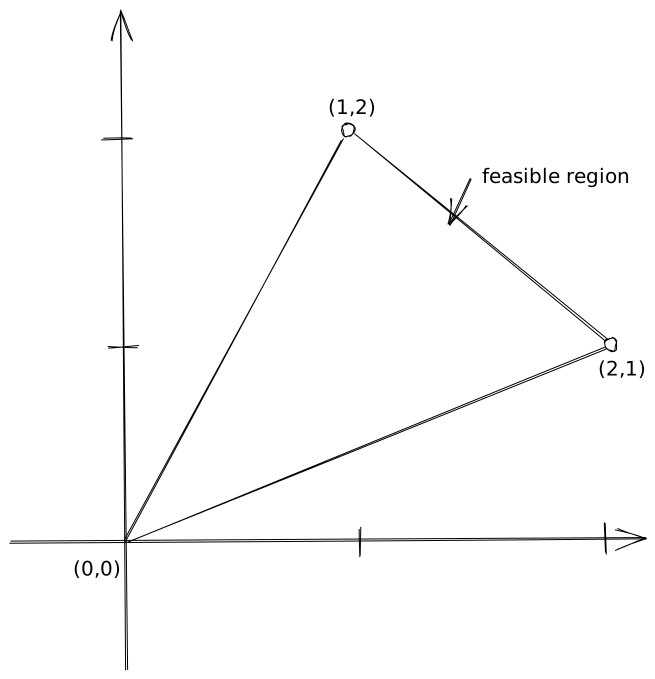
For example to get the line at the bottom set $p = 1$ $\{(2q, q) \vert q \in [0,1]\}$, for the line at the top set $p=0$ $\{((1-q), 2(1-q)) \vert q \in [0,1]\}$. For lines in-between let $p$ vary.
# Security region
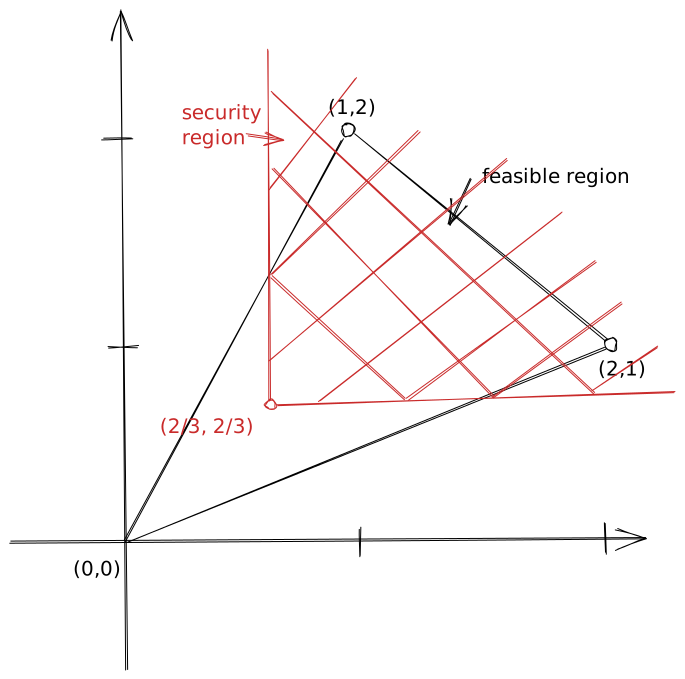
In the Battle of the sexes example we have plotted the security region below.
# Folk Theorem
We would like to think we could get any point which is feasible and in the security region with sufficient cooperation. That cooperation will have to be enforced with a penalty, such as forcing the opposition player into the Minmax profile . This will look as follows.
If we follow through with the threat in the Grim trigger strategy this might actually be sub-optimal play for us - and we might not want to do it. So this threat is some what implausible.
# Pavlov
This strategy feels counter intuitive - like a punch me twice and its all ok mentality.
The strategy is in Nash equilibrium with itself, as both players start out cooperating and will continue forever. However it is also Subgame perfect and therefore a plausible threat. To see this lets start a game in every previous state. We will represents turns as $(*,*)$ where the first position is what player $A$ did and the second is what player $B$ did. There are two options are moves cooperate $C$ and defect $D$.
$$ \begin{array}{c|cc} \ \mbox{Last} & 1 & 2 \\ \hline (C,C) & (C,C) & (C,C) \\ (C,D) & (D,D) & (C,C) \\ (D,C) & (D,D) & (C,C) \\ (D,D) & (C,C) & (C,C) \end{array} $$
We see from this no matter what happened last round the Pavlov strategy self rights itself into the cooperate cooperate state.
# Stochastic games
Stochastic games are the multi-agent analogy to a Markov decision process .
# Generalisations for zero-sum Stochastic games
In the zero-sum setting we assume only two players, so $i = 2$. However, we leave the terminology general for syntactic ease.
This has some nice properties
- Value iteration works,
- It converges,
- $Q_i$ has a unique solution for each $i$,
- Policies can be computed independently from one another,
- We can update in polynomial time , and
- Q-functions are sufficient to specify the policy.
# Generalisation to Stochastic games
You can do the same for non-Zero-sum game s using Nash equilibrium instead of minmax but it doesn’t have the nice properties.
This has some nice properties
- Value iteration doesn’t works,
- It doesn’t converges,
- $Q_i$ has a multiple solution for each $i$ (as there is no unique Nash equilibrium ),
- Policies cannot be computed independently from one another,
- We can update in PPAD time , and
- Q-functions are not sufficient to specify the policy.
Though there are ideas to correct for this:
- We can use repeated Stochastic games ,
- You can talk to players,
- You can limit players computational power, and
- Allowing players to pay each other some of their reward.