# Week 10 - NP overview
Last edited: 2023-11-11
# Complexity classes
Nondeterministic Polynomial time (NP)
In this class we use the search problem definition.
Note here we have.
There is an open problem.
P equals NP or P not equals NP
# Satisfiability
The Satisfiability problem is in NP
# k-colourings problem
The k-colourings problem is in NP
# MST
Minimum Spanning Tree problem is in NP
This proof was relatively easy as MST is a polynomial time problem. This is shown by what is above and Kruskal’s algorithm .
# Knapsack problem
Whilst the Knapsack problem is of the correct form to be a search problem we can’t currently check if a solution is correct in polynomial time. Therefore the Knapsack problem isn’t known to be in NP .
Similarly we say that the Knapsack problem isn’t known to be in polynomial time either.
We say it isn’t known to be as there might be a super clever algorithm that happens to solve the Knapsack problem in polynomial time.
However, there is a variant of the problem that is in NP .
Here instead of having to check if a solution is maximal we can instead just check if it has enough value.
# Polynomial time and Nondeterministic Polynomial time
Note that NP isn’t Not Polynomial time . In fact we have the following result.
Polynomial time is a subset of NP-complete
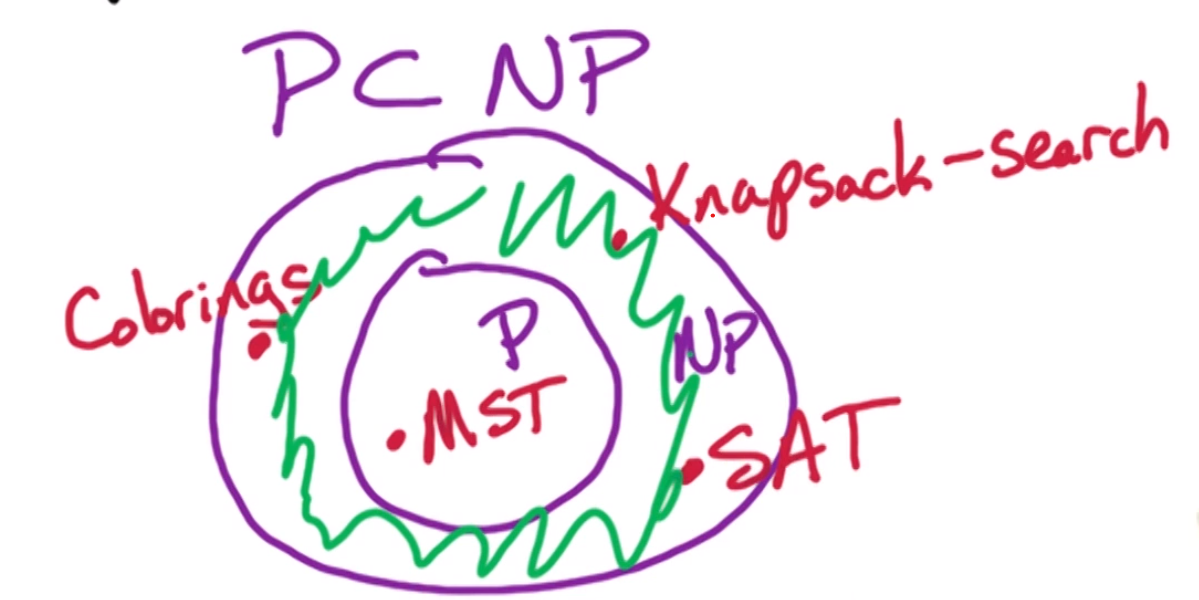
The question is, are there problems that are in NP but are not in P ?
# NP-complete
If P not equal to NP then we would have a problem in NP that didn’t lie in P . Therefore the green region above would be non-empty.
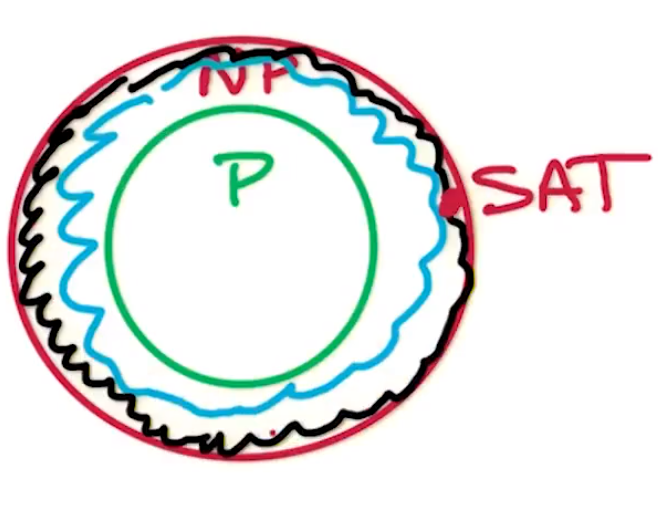
Therefore lets look at the hardest problems in NP .
We define a many-one reduction as bellow.
However, we want to look at the hardest problems in NP .
A classic NP-Complete problem is the SAT problem .
# Reductions functionally
To show a many-one reduction from $A$ to $B$ you need to construct $f$ a way to transform an instance of problem $A$ into some input to the problem $B$. This needs to be done in polynomial time. Then the solution from solving $f(I)$ in problem $B$ should relate back to the solution of problem $A$. Either you should construct $h$ a way to transform the solution from problem $B$ into a solution to problem $A$ or forward on the fact that no solution can exist.
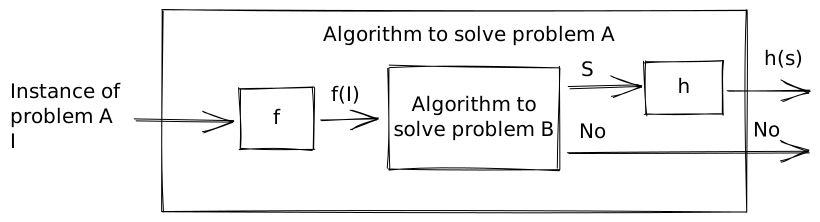
Therefore to show $A$ reduces to $B$ we need:
- Define $f$: Show how an instance of problem $A$ can be converted into an instance of problem $B$ in polynomial time.
- Define $h$: Show how a solution to the problem $B$ can be converted into a solution to problem $A$ in polynomial time.
- Proof: Show that a solution for $B$ exists if and only if a solution to $A$ exists.
# Showing NP-Complete
To show a problem $A$ is NP-Complete need to show
Generically showing $A$ is NP-hard , is ironically quite hard. However we get around this by having some NP-complete problems already, such as the SAT problem . Then to show $A$ is NP-hard we just need to show another NP-Complete problem reduces to it. So functionally we show:
- $A$ is NP , and
- there is some NP-complete problem $B$ that reduces to $A$.
# Practice problems
From Algorithms by S. Dasgupta, C. Papadimitriou, and U. Vazirani.