Transmission Control Protocol (TCP)
networks
Transmission Control Protocol (TCP)
The transmission control protocol is a layer 4 protocol that allows for multiplexing and a duplex communication channel. It is defined in RFC793. This is a connection orientated protocol which establishes a connection with TCP 3 way handshake and closes connections with the TCP connection teardown. This gaurentees the following features.
- reliability: every message will be received and acknowledge or it will be redelivered,
- ordered delivery: messages have a sequence number and will only be parsed to the Application layer in order,
- error checking: Checksum in layer 4,
- Transmission control in TCP:
- Flow control: allow the receiver to dictate how many message it can buffer.
- Congestion control and fair usage: will use connection probing to determine a safe and fair transmission rate.
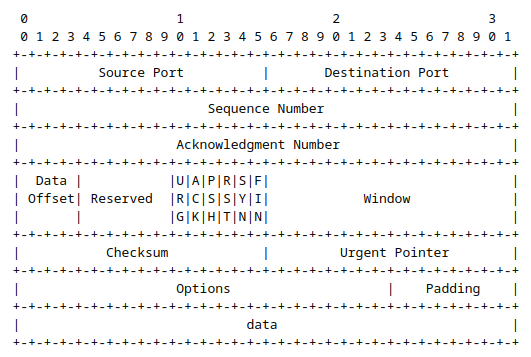
The TCP header has the following fields:
- Source port,
- Destination port,
- sequence number: the sequence number of the first data octect, this has a special role in the TCP 3 way handshake,
- Acknowledgement number: the next sequence number the receiver is expecting to get,
- Data offset: the number of 32 bit words in the TCP header,
- Reserved: set to all 0’s,
- control bits: these are 0 or 1 for the following 6 fields Urgent, Acknowledgement, Push, Reset, Synchronise, and Finish.
- Window: The number of data octets number of data octets the sender of this segment is willing to receive.
- Checksum: Checksum in layer 4,
- Urgent pointer,
- Options, and
- Padding to make the header a multiple of 32 bits.
Flow control in TCP
Suppose [host](host_(networks).md) A is transmitting data to [host](host_(networks).md) B. When this starts up [host](host_(networks).md) B will reserve some amount of memory to buffer unprocessed packages. Lets say it can fit `RcvBuffer` bytes. Then it keeps track of `LastByteRead` and `LastByteRecieved`