OMSCS
Pages in this section
- CS6035 O01 Introduction to Information SecurityLast edited: 2026-01-28
Introduction to Information Security is a graduate-level introductory course in information security. It teaches the basic concepts and principles of information security, and the fundamental approaches to secure computers and networks.
Main topics include:
- Security basics
- Security management and risk assessment
- Software security
- Operating systems security
- Database security
- Cryptography algorithms and protocols
- Network authentication and secure network applications
- Malware
- Network threats and defences
- Web security
- Mobile security
- Legal and ethical issues
- Privacy
# Links
- CS6200 Graduate introduction to Operating SystemsLast edited: 2023-12-03
This is a graduate-level introductory course in operating systems. This course teaches the basic operating system abstractions, mechanisms, and their implementations. The core of the course focuses on OS support for concurrency (threads) and synchronisation, resource management (CPU, memory, I/O), and distributed services. The practical component of the course teaches multi-thread programming, inter-process communication, and distributed interactions via RPC.
BreakI retook this course so there is a slight break in dates between lectures 4 and 5. The content was the same for both times I took it.
- CS6210 Advanced Operating Systems
Last edited: 2025-12-03Advanced Operating Systems is a graduate-level course that addresses a broad range of topics in operating system design and implementation, including:
- Operating system structuring
- Synchronization, communication, and scheduling in parallel systems
- Distributed systems, their communication mechanisms, distributed objects and middleware
- Failures and recovery management
- System support for Internet-scale computing By tracing the key ideas of today’s most popular systems to their origins in research, the class highlights key developments in operating system design over the last two decades and illustrates how insight has evolved to implementation.
# Links
- CS6215 Introduction to Graduate Algorithms
Last edited: 2023-12-03This course is a graduate-level course in the design and analysis of algorithms. We study techniques for the design of algorithms (such as dynamic programming) and algorithms for fundamental problems (such as fast Fourier transform FFT). In addition, we study computational intractability, specifically, the theory of NP-completeness. The main topics covered in the course include: dynamic programming; divide and conquer, including FFT; randomized algorithms, including RSA cryptosystem; graph algorithms; max-flow algorithms; linear programming; and NP-completeness.
- CS6250 Computer Networks
Last edited: 2025-12-05This course provides a quick refresher on introductory material and offers broad coverage of protocols and algorithms that span all layers of the Internet protocol stack.
The course begins with an overview of the evolution of the Internet architecture and a short refresh of the transport layer algorithms and protocols such as TCP and congestion control. Next, the course will dive into intradomain/interdomain routing, peering and networks relationships with a follow-up into router design and functionalities. After discussing routing and router technologies, the course will continue with Software Defined Networking technologies and discuss topics that intersect Network Security and Computer Networks, for example, attacks on Internet routing such as BGP hijacking. Finally, the course wraps up with a discussion on multimedia applications and Content Delivery Networks.
- CS7641 Machine Learning
Last edited: 2024-01-10This is a 3-course Machine Learning Series, taught as a dialogue between Professors Charles Isbell (Georgia Tech) and Michael Littman (Brown University).
Supervised Learning Supervised Learning is a machine learning task that makes it possible for your phone to recognize your voice, your email to filter spam, and for computers to learn a number of fascinating things. This sort of machine learning task is an important component in all kinds of technologies. From stopping credit card fraud; to finding faces in camera images; to recognizing spoken language - our goal is to give students the skills they need to apply supervised learning to these technologies and interpret their output. This is especially important for solving a range of data science problems.
- CS7642 Reinforcement Learning
Last edited: 2024-01-10The course explores automated decision-making from a computational perspective through a combination of classic papers and more recent work. It examines efficient algorithms, where they exist, for learning single-agent and multi-agent behavioral policies and approaches to learning near-optimal decisions from experience.
Topics include Markov decision processes, stochastic and repeated games, partially observable Markov decision processes, reinforcement learning, deep reinforcement learning, and multi-agent deep reinforcement learning. Of particular interest will be issues of generalization, exploration, and representation. We will cover these topics through lecture videos, paper readings, and the book Reinforcement Learning by Sutton and Barto.
- CS8803 O08 Compilers - Theory and Practice
Last edited: 2026-01-28The objective of this course is to learn the theory and practice behind building automatic translators (compilers) for higher level programming languages and to engineer and build key phases of a compiler in Java or C++ for a small language.
# Links
- CSE6220 Introduction to High Performance Computing
Last edited: 2026-01-28This course is a graduate-level introduction to scalable parallel algorithms. “Scale” really refers to two things: efficient as the problem size grows, and efficient as the system size (measured in numbers of cores or compute nodes) grows. To really scale your algorithm in both of these senses, you need to be smart about reducing asymptotic complexity the way you’ve done for sequential algorithms since CS 101; but you also need to think about reducing communication and data movement. This course is about the basic algorithmic techniques you’ll need to do so. The techniques you’ll encounter cover the main algorithm design and analysis ideas for three major classes of machines: for multicore and manycore shared memory machines, via the work-span model; for distributed memory machines like clusters and supercomputers, via network models; and for sequential or parallel machines with deep memory hierarchies (e.g., caches). You will see these techniques applied to fundamental problems, like sorting, search on trees and graphs, and linear algebra, among others. The practical aspect of this course is implementing the algorithms and techniques you’ll learn to run on real parallel and distributed systems, so you can check whether what appears to work well in theory also translates into practice. (Programming models you’ll use include OpenMP, MPI, and possibly others.)
- Online Masters of Science in Computer Science Notes
This masters program from Georgia Tech is aimed at making rigorous computer science education accessible to all through an affordable programme on an accessible platform.
# Resources
- Week 0 - Assumed knowledge
Last edited: 2026-02-05# Notes from Fundamentals course
I followed this Fundamentals course to understand the basics.
# Lecture 1: Hosts and devices
Some terminology first:
- Week 1 - Are you ready?
Last edited: 2026-02-05# C Programming
Because this course focuses on operating systems, primarily covering Linux, it assumes that students have a reasonable understanding of the C programming language.
# Concepts to Know
For this course, a “reasonable understanding” would be defined as having used or been exposed to the following C concepts:
- Week 1 - Basic Model of Locality
Last edited: 2026-01-28This lecture is based on the paper:
High performance computingThis is a bad name, all computing should be high performance. This course is really about supercomputers, where you need to extract every last ounce of compute you have to solve the problem faster.
- Week 1 - Chapter 1 Machine Learning
Last edited: 2024-01-13This is my notes from the first chapter of MachineLearningTomMitchell.pdf .
1.1 Well posed learning problems
CheckersIf we want a programme to learn at checkers we simply need to define $T$, $P$, and $E$!
- Week 1 - Chapter 3, Finite Markov Decision Process
Last edited: 2026-02-05Compulsory reading from Reinforcement learning: An introduction .
# Finite Markov Decision Process
Finite Markov Decision Process
Using the function $p$ (defined in the finite Markov decision process), we can calculate some other probabilities.
State transition probability: When in state $s_t$ and you take the action $a_t$ the probability of ending up in $s_{t+1}$:
- Week 1 - Course material
Last edited: 2026-02-05# Reference Books
- Week 1 - Decision Trees
Last edited: 2024-01-10Supervised learning
Supervised learning falls into two main problems sets
Classification problems - Mapping from a domain to some discrete set, and Regression problems - mapping from a domain to some continuous space like the Real numbers ($\mathbb{R}$).
For example, making a decision on whether you should give someone a loan is a classification problem as there are only two outcomes - whereas mapping from someone’s picture to their age would be a regression problem.
- Week 1 - Dynamic Programming
Last edited: 2025-12-05Dynamic programming is a method to speed up recursion especially when the recursive algorithm computes the same step multiple times.
by recursion
- Week 1 - Introduction
Last edited: 2026-02-05Here are some questions you should be able to answer to start the course:
• What are the advantages and disadvantages of a layered architecture? Modularity, Separation of concerns, and interchange of methods at different layers. Duplication of effort, more covert coupling, and additional overhead. • What are the differences and similarities between the OSI model and the five-layered Internet model? Connection between OSI and IPS models • What are sockets? Socket • Describe each layer of the OSI model. OSI • Provide examples of popular protocols at each layer of the five-layered Internet model. HTTP TCP ARP • What is encapsulation, and how is it used in a layered model? encapsulation • What is the end-to-end (e2e) principle? End to end principle • What are the examples of a violation of e2e principle?
- Week 1 - Introduction to Compilers
Last edited: 2026-01-28CompilerA program that translates source code written in one programming language into another programming language. Commonly the target programming language is machine code that is executable.
- Week 1 - Introduction to operating systems
Last edited: 2026-02-05# Metaphor
The OS is a lot like a toyshop manager. They are required to:
- Direct the operational resources
- Controls the use of employees’ time,
- Distribute tools and parts between workers
- Enforces working policies
- Ensures fairness between workers,
- Make sure toys are made safely,
- How to clean up after the job has been completed.
- Mitigates difficulty of complex tasks
- Simplifies operations for each worker to do,
- Chooses optimal task allocation to improve performance.
In comparison an OS does the following:
- Week 1 - Knapsack Problem
Last edited: 2026-02-05# Week 1 - Knapsack Problem
There are different versions of this problem:
- Where you can have at most one version of each object,
- Where you can have at most a given number of each object, and
- Where you can have an infinite amount of each object.
We will focus on the first problem for the next sections.
- Week 1 - Security Mindset
Last edited: 2026-01-28We need security when two things are met:
We have something of value, and
We have a threat to that thing.
# Things of value
In the context of cyber security usually the thing of value is information. However, there are examples of using cyber attacks to attack things in the physical world such as the Stuxnet attack on Iran’s nuclear facility or digital attacks on electric grids.
- Week 1 - Smoov & Curly's Bogus Journey
Last edited: 2025-05-12# Review
The first part of this course is a review of:
Week 12 - Reinforcement learning
There is a change of notation within this course compared to the referenced lecture. Instead of using $U(s)$ for the utility, we use $V(s)$ for value. Instead of considering the reward function $R: S \rightarrow \mathbb{R}$, we consider it $R: S \times A \rightarrow \mathbb{R}$, i.e. the reward takes into account the action you have taken. Therefore, the Bellman equation in this notation is restated below.
- Week 1 - Supplementary Introduction to Reinforcement Learning
Last edited: 2025-05-13Going down in levels of specificity:
- Artificial intelligence: The ability of machines to simulate human behaviour.
- Machine learning: The ability of machines to simulate human behaviour by learning from data.
- Reinforcement Learning: The ability of machines to simulate human behaviour by learning from data that is simultaneously sequential, evaluative, and sampled.

Later in the course we will be adding deep learning into our use of reinforcement learning . This is mainly using large neural networks to assist with the learning process.
- Week 1 - Writing and reading papers
Last edited: 2024-01-21# Ten simple rules for reading a scientific paper by Maureen A. CareyID, Kevin L. Steiner, William A. Petri Jr
Reading articles is a large part of research and you should try to keep up to date with your area of interest. However, may people struggle with reading articles and this guide is some tips and tricks for starting.
- Week 10 - Failures and Recovery
Last edited: 2025-11-30# Week 10 - Failures and Recovery
Within an operating system, crashes will occur. When they do they need to leave us in state we can recover from. To do this we need persistence and recovery.
# Lightweight Reliable Virtual Memory (LRVM)
Whilst the operating system and its subsystems are changing objects in memory if a crash occurs before it has a chance to save it to disk it can leave the OS in a broken state. To combat this LRVM creates an interface to make some objects in virtual memory persistent on the disk. The key to this working is to make this fast and have a clean, easy to use interface for subsystem designers.
- Week 10 - Feature selection
Last edited: 2026-02-05Feature selection is the process of deciding what features of the data are worth training on. Then picking the subset of them that are the most important. The reason to do this is:
- Knowledge discovery, interpretability, and insight.
- When you get the results back you are going to have to be able to explain them.
- The curse of dimensionality
- If you put too many dimensions in - it will decrease the accuracy of your models!
# How hard is this problem?
Assume we want to know the best $m \leq n$ subset of columns. The only way to verify it is the best is to check them all so it is $\binom{n}{m}$. If you don’t know $m$ then it is $2^n$.
- Week 10 - Feature transformation
Last edited: 2026-02-05Feature transformation is the problem of pre-processing a set of features to create a new (smaller/compact) feature set, while retaining as much information as possible. It is a map $p: \mathbb{F}^N \rightarrow \mathbb{F}^M$ where you usually want $M < N$.
In this course we will focus on linear feature reduction where $p$ is a linear map .
NoteFeature selection is a special case of feature transformation
- Week 10 - Graph problem complexity
Last edited: 2023-11-19# Independent set problem
Therefore we have the following problem.
Though this problem is not known to be in NP as to verify if a set is the largest set we would require to calculate the set of largest size. However, we can edit this question to make one that is in NP .
- Week 10 - NP overview
Last edited: 2023-11-11# Complexity classes
Nondeterministic Polynomial time (NP)
In this class we use the search problem definition.
Note here we have.
There is an open problem.
- Week 10 - NP-completeness
Last edited: 2023-11-11We are going to assume the following.
# k-SAT
We are going to show that the k-SAT problem is NP-Complete for $k \geq 3$.
To do this we will show 3-SAT is NP-complete which as 3-SAT is a subproblem to k-SAT for $k \geq 3$ this will prove all we need to.
- Week 10 - Synchronization Constructs
Last edited: 2025-03-26# Additional reading
# Synchronization
Previously we discussed mutexes and condition variables . However these had a couple of downsides:
- Week 10 - Video applications
Last edited: 2026-02-05# Additional reading
# Important Readings
VoIP: A comprehensive survey on a promising technology https://www.sciencedirect.com/science/article/abs/pii/S1389128609001200Links to an external site.
MPEG: A Video Compression Standard for Multimedia Application https://dl.acm.org/doi/pdf/10.1145/103085.103090Links to an external site.
The JPEG Compression standard https://ieeexplore.ieee.org/document/125072Links to an external site.
- Week 11 - CDNs and overlay networks
Last edited: 2026-02-05# Reading
# Important Readings
The Akamai Network: A Platform for High-Performance Internet Applications https://dl.acm.org/doi/10.1145/1842733.1842736Links to an external site.
Open Connect Everywhere: A Glimpse at the Internet Ecosystem through the Lens of the Netflix CDN https://arxiv.org/pdf/1606.05519.pdf Links to an external site.
- Week 11 - IO management
Last edited: 2025-04-09# Model of a IO device
Whilst an IO device can come in many forms we model them similarly.

These have 3 registers:
- Status: Some indicate the state of the device.
- Command: Used by the CPU to control the device.
- Data: Used to transfer data in and out of the device.
Then what happens internally is controlled by the micro controller on the device.
- Week 11 - Linear Programming
Last edited: 2023-11-13In broad terms a linear programme is an optimisation problem of a linear function where there are linear bounds on the variables.
We are given a directed graph $G = (V,E)$ with capacities $c: E \rightarrow \mathbb{R}_{>0}$ and source $s \in V$ and sink $t \in V$.
- Week 11 - Markov Decision Processes
Last edited: 2024-04-03Find homeSuppose we have a world with 12 states defined by a 2d grid $S = \{(x,y) \vert 1 \leq x \leq 4, 1 \leq y \leq 3\}$. Where state $(2,2)$ is can’t be entered, $(4,3)$ is home, $(4,2)$ is a pit of death, and $(1,1)$ is where we start.
- Week 11 - Security
Last edited: 2026-01-28# Principles of information security
Information security is a large part of the developer industry. This field has whole masters courses dedicated to its study. However, lots of the modern terminology was invented by visionaries in the early years of computer history.
The notes in this section are based on the following paper:
Protection and the Control of Information in Computer Systems
- Week 12 - Future of the Internet
Last edited: 2026-02-05# Reading
# Optional Readings
Machine Learning and Networking Applications
Routing or Computing? The Paradigm Shift Towards Intelligent Computer Network Packet Transmission Based on Deep Learning https://ieeexplore.ieee.org/document/7935536
CherryPick: Adaptively Unearthing the Best Cloud Configurations for Big Data Analytics https://www.usenix.org/system/files/conference/nsdi17/nsdi17-alipourfard.pdf
- Week 12 - Halting problem
Last edited: 2023-11-13We want to show that that this problem is computationally impossible or in other words it is undecidable .
- Week 12 - Knapsack complexity
Last edited: 2023-11-13We are going to prove that the Knapsack-search is NP-complete . We will do this using the 3-SAT but first going through the Subset-sum problem .
# Subset-sum problem
This can be solves using Dynamic Programming in a similar way to the Knapsack problem in $O(nt)$. However, similar to the Knapsack problem this is not a polynomial time algorithm in the length of the input as that is $n\log_2(t)$. Therefore it is Pseudo-polynomial .
- Week 12 - Max-SAT approximation algorithm
Last edited: 2023-11-19In this lecture we consider the a similar problem to the SAT problem .
This is NP-hard .
Therefore it is unlikely to find any algorithm that will solve the problem quickly. However we will look at using linear programming to approximate a solution.
# Approximate algorithms
Let $f$ be a boolean function in CNF with $m$ clauses. Let $m^{\ast}$ denote the solution to the max-SAT problem for $f$.
- Week 12 - Reinforcement learning
Last edited: 2024-04-06There are 4 kinds of process we think about:
- Planning:
- Input: Model (such as Markov decision process )
- Output: Policy
- E.g. Value iteration (MDP) or Policy Iteration (MDP)
- Learning:
- Input: Transitions
- Output: Policy
- E.g. Reinforcement learning
- Modelling:
- Input: Transitions
- Output: Model
- Simulation:
- Input: Model
- Output: transitions
We can compose these strategies in two major ways.
- Week 12 - Virtualization
Last edited: 2025-04-12# Additional reading
# Virtualization
Benefits for virtualization:
- Consolidation: Allows you to split one machine into many, allowing you to consolidate different applications that need different environments to run.
- Migration: Makes it easy to move applications from one machine to another.
- Security: Isolates applications from one another.
- Debugging: Makes it easy to spin up similar instances of crashed programs to debug.
- Support for legacy OS: Easy to host an application that needs a legacy operating system to run.
- Support for OS research: Makes it easy to change an operating system and observe the effects of that.
There are two main methods of virtualization:
- Week 13 - Game theory
Last edited: 2026-02-05# 2-player zero-sum finite game of perfect information
This is a lot of words but these games are like tick tack toe or noughts and crosses. Whilst these are fun they all boil down to a payoff matrix for the different strategies you take. Like the following
$$ \begin{array}{c|ccc} \ 1 & a & b & c\\ \hline x & 1 & 0 & -1 \\ y & -1 & 0 & 1 \\ \end{array} $$to read this table, if the first player at the top picks action $a$ and the second player on the rows picks $x$ then player one gets 1 point whereas player two gets -1 point. This is the zero-sum aspect to the game. (Note the game could be non-deterministic but we just take expectation to find the values in the grid.)
- Week 13 - Known NP-complete problems
Last edited: 2023-11-19# Week 13 - NP-complete problems
The following problems are known to be NP-complete :
- Lectures
- SAT problem - SAT is NP-complete
- k-SAT - k-SAT is NP-complete for k greater than or equal to 3
- Independent set of a given size - Independent set of a given size is NP-complete
- Clique of a given size problem - Clique of a given size problem is NP-complete
- Vertex cover of a given size - Vertex cover of a given size is NP-complete
- k-colourings problem (graphs) - The k-colourings problem is NP-complete
- Knapsack-search - Knapsack-search is NP-complete
- Subset-sum problem - Subset-sum problem is NP-complete
- Book
- Week 13 - Remote Procedure Calls
Last edited: 2025-04-12# Additional reading
# Remote procedure calls (RPC)
To achieve this RPC has some requirements:
- Offers a client and server interface.
- Implements a procedure call Interface.
- When RPC was invented procedural languages were big, this is synchronous and when it is called remote procedure call.
- Type checking.
- This offers error handling, and
- packet bytes interpretation.
- Cross-machine conversations.
- Higher-level protocol.
- Access control, fault tolerance, and
- Can support different transport protocols.
Below is an example flow of an RPC call:
- Week 14 - Distributed file systems
Last edited: 2026-02-05# Additional reading
“Caching in the Sprite Network File System”
# Distributed file system
There are different models for distributing files:
- Client/server model: A client with the file system talks to a single server who has all the files.
- Client/server-cluster: A client contacts a cluster of servers who all have files the client can get files from. This can take different forms
- Replicated: Each server has all the files.
- Partitioned: each server serves part of the file system.
- Both: Files are replicated and partitioned between machines (this is functionally how most large providers operate).
- Peer-to-peer: A cluster of computers act as peer backups for one another. (This will be covered in more detail next lecture.)
# Implementation
There are different models for a Distributed file system (DFS) in the client server model.
- Week 15 - Distributed shared memory
Last edited: 2025-04-13# Additional reading
# Distributed shared memory
Distributed shared memory is similar to a distributed file system however all clients are also clients to others. They share the state mutually.
- Week 15 - Markov Chains
Last edited: 2026-02-05To talk about Markov chain it is good to recap what a probability matrix is:
Now we can define a Markov chain .
Simple Markov chainSuppose we have 4 states with the following probabilities to go between them. This is commonly represented as a edge weighted directed graph .
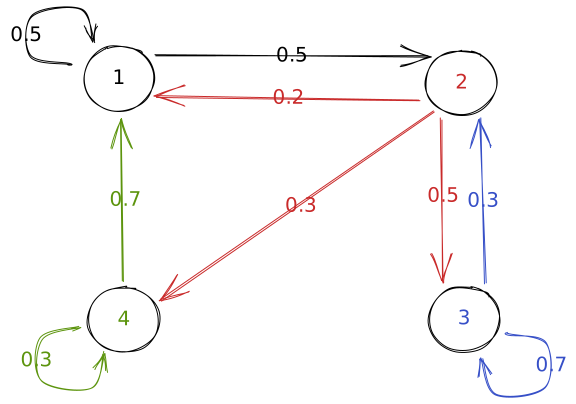 In terms of a probability matrix
it would be represented as
In terms of a probability matrix
it would be represented as- Week 16 - Datacenter technologies
Last edited: 2026-02-05# Week 16 - Data-center technologies
# Internet services
An internet service is simply one offered over a web interface. These normally consist of 3 layers:
- Presentation: Static content.
- Business logic: Dynamic content.
- Database tier: Data storage.
Whilst these layers are separated here they may be implemented on the same machine. Middleware can be offered to integrate the different layers together.
- Week 2 - Cache-Oblivious Algorithms
Last edited: 2026-01-23Optional readingThis lecture is optional reading in my course and will not be examinable.
- Week 2 - Chain Matrix Multiply
Last edited: 2023-12-03The goal is this problem is, given a number of matrices what is the most efficient way to multiply them together?
Lets say we have matrices $A$, $B$, $C$ and $D$ and they have different sizes such that we can multiply $A B C D$. Whilst matrix multiplication might be associative there might be a more efficient way to multiply them together!
- Week 2 - I/O Avoiding Algorithms
Last edited: 2026-01-22In this lecture, we will examine different classical algorithms and try to calculate their number of transfers in the Von Neumann model introduced in the previous lecture.
# Merge sort
Merge sort divides the array into small chunks. Then merges each of those chunks into one another to produce a sorted array. This runs in $O(n \log n)$ time. So there are two steps to this:
- Week 2 - Neural networks
Last edited: 2026-02-05The basis of all neural networks is a simplified model of a neuron in the human body.
Where we define an activation function as.
First we will just take the function to be Binary step which introduces an extra parameter $\theta$.
- Week 2 - OS Structure Overview
Last edited: 2025-08-29The OS structure is the way OS is organised with respect to the applications it serves and the underlying hardware it manages.
Some desirable traits for this to have are:
- Protection: Defending the user from the OS’s activities but also the OS from anything run by the user. Similarly each user from one another.
- Performance: The time taken to run the services the OS offers.
- Flexibility: The ability to adapt the services the OS offers for different use cases.
- Scalability: The performance of the OS increases as the resources provided increases.
- Agility: Adapting to changes in application needs or resource availability.
- Responsiveness: The ability to respond to events in a timely manner.
# Different OS Structures
# Monolithic OS
In a monolithic OS, all OS services run in a separate address space than user applications. This means all access to the underlying hardware requires a context switch to kernel space.
- Week 2 - Processes and Process Management
Last edited: 2026-02-05# Aside
# Metaphor
A process is like an order of toys:
- State of execution:
- Completed,
- waiting, or
- In progress.
- Parts and temporary holding area
- Pieces used to make the toy, or
- Containers to put the pieces.
- May require special hardware:
- Sewing machine or
- glue gun.
- Week 2 - Regression and classification
Last edited: 2024-01-17Regression history
The name comes from regression to the mean , this was the technique they used to first talk about it - then the word regression for the technique stuck.
Polynomial Regression
Once we have an objective function we can use training data to fit the parameters $c_{p}$.
- Week 2 - Regular expressions and DFA
Last edited: 2026-01-28In the lexical analysis phase of the compiler we need to convert a sequence of characters into tokens. First, let’s define formally what a token is.
TokenA token is a tuple consisting of:
- Week 2 - Reinforcement Learning Basics
Last edited: 2025-05-14When evaluating different learners we normally evaluate them by the policy they produce. However, different methods of learning can create policies in different ways - therefore we may need to also consider:
- Computation complexity: The time it takes for that learner to come up with that policy.
- Sample complexity: The amount of interactions with its environment it needs to come up with that policy.
We don’t normally think about space complexity unlike other subjects - since that is not normally a limiting factor.
- Week 2 - Shortest Paths
Last edited: 2025-12-05Shortest path problemGiven a directed graph $(V, E)$ with edge weights $w: E \rightarrow \mathbb{R}$ and a start vertex $s \in V$ - the shortest path problem is to find the shortest distance between $s \in V$ and $z \in V$ for every $z$. This is called $\mbox{dist}(z)$ with the formal definition
- Week 2 - Temporal Difference Learning
Last edited: 2025-05-20Within reinforcement learning there are broadly 3 types of algorithms:
- Model-based: These algorithms first aim to understand the environment by building or learning an explicit model of it. This model describes how the environment behaves (e.g., transition probabilities and rewards).
- Model Learning/Update: Run through an example (an interaction with the environment) to collect data and update the parameters of a MDP model. This typically involves estimating state transition probabilities and reward functions.
- Planning/Solving: Use the learned MDP model (e.g., using algorithms like Value iteration (MDP) or Policy Iteration (MDP) ) to generate an optimal (or near-optimal) value function .
- Policy Derivation: Use the calculated value function and the learned model to derive an optimal policy . This policy dictates the best action to take in each state, often by choosing the action that maximizes the expected future reward (e.g., using argmax over the Q-values derived from the value function and model).
- Value-function based (model-free): These algorithms bypass the need to build an explicit model of the environment. Instead, they directly learn a value function
(or action-value function) that estimates the goodness of states or state-action pairs.
- Value Function Update: Run through an example (an interaction with the environment) and use the observed outcomes (rewards and next states) to directly update the value function . This might be a state-value function V(s) or, more commonly, an action-value function Q(s,a), which estimates the expected return of being in state s and taking action a.
- Policy Extraction: Implicitly or explicitly derive a policy for each state by evaluating the actions that lead to the highest estimated value. For Q-functions, this often means choosing the action a that maximizes Q(s,a) for a given state s.
- Policy Search (or Policy Optimization): This approach directly searches for an optimal policy
without necessarily learning a value function or a model. The goal is to find a policy that directly maps states to actions and maximizes the cumulative reward.
- Policy Evaluation and Update: Run through an example using the current policy . Based on the observed outcomes (rewards and trajectories), directly update the parameters of the policy to improve its performance. This often involves gradient-based methods where the policy parameters are adjusted in the direction that increases the expected return.
The different approaches have varying trade-offs. Generally, model-based approaches are often more computationally intensive for the planning step but can be more sample efficient (requiring fewer interactions with the environment) because they can “plan” internally without needing new real-world data for every decision. Conversely, model-free approaches (including value-function based and policy search) are typically less computationally intensive per update (as they don’t involve a full planning step) but are often more sample intensive, requiring many interactions with the environment to learn effectively. Policy search methods, in particular, can be good for continuous action spaces and may sometimes converge faster than value-based methods in certain complex scenarios, but they can also be more prone to local optima.
- Week 2 - Transport and application layer
Last edited: 2024-05-24# Important Readings
CUBIC: A New TCP-Friendly High-Speed TCP Variant https://www.cs.princeton.edu/courses/archive/fall16/cos561/papers/Cubic08.pdfLinks to an external site.
# Book References
Kurose-Ross (Edition 6): Sections 3.1.1, 3.2, 3.3, 3.4, 3.5.5, 3.6
Peterson Section 6.3
# Optional Readings
Congestion Avoidance and Control https://ee.lbl.gov/papers/congavoid.pdfLinks to an external site.
- Week 3 - Ensemble Bagging and Boosting
Last edited: 2024-01-24The idea of Ensemble learning is to look at a subset of data and try to model that well. If we do that to enough small patches we hope we can combine this to give us a good overall understanding of the data.
This is a powerful idea when the function we are trying to map doesn’t globally generalise but instead locally generalises like when people try to filter out spam from your inbox.
- Week 3 - Fast Integer Multiplication
Last edited: 2025-12-05Multiplying $n$-bit integers problemGiven $n$-bit integers $x$ and $y$ what is $z = xy$?
- Week 3 - Instance Based Learning
Last edited: 2025-12-05# K-nearest neighbour
# Run times
Instance-based learning is often called “lazy” learning because you delay computation until query time. As you can see in the table below, we assume $A = B = \mathbb{R}$ and that the input training data is sorted.
- Week 3 - Intradomain routing
Last edited: 2024-05-29# Important Readings
Experience in Black-box OSPF Measurements http://conferences.sigcomm.org/imc/2001/imw2001-papers/82.pdfLinks to an external site.
# Book References
If you have access to the Kurose-Ross book and the Peterson book, you can find the list of chapters discussed in this lecture. As mentioned in the course schedule, purchasing the books is not required.
- Week 3 - Linear-Time Median
Last edited: 2025-12-05Median list problemGiven an unsorted list $A = [a_1, \ldots, a_n]$ of $n$ numbers - you want to find the median ($\lceil \frac{n}{2} \rceil$) element.
- Week 3 - Regular expressions and NFA
Last edited: 2026-01-19This lecture focuses on how to construct a DFA from a given RegEx algorithmically. To do this we will:
Introduce an easier object to work with called a Non-deterministic Finite Automaton (NFA).
Show that operations in RegEx can be converted into ways to combine NFAs together.
We will prove that an NFA can be converted into a DFA.
We will try to minimise this representation.
This will give us the algorithm to go from RegEx to a minimal DFA.
- Week 3 - Solving Recurrences
Last edited: 2023-11-11# $T(n) = 4T\left (\frac{n}{2}\right ) + O(n)$
First step is to replace the Big-O notation . Let $c > 0$ such that
$$T(n) \leq 4 T\left ( \frac{n}{2} \right ) + cn, \mbox{ and } T(1) \leq c.$$Lets keep reapplying this inequality
$$\begin{aligned} T(n) \leq & cn + 4T\left ( \frac{n}{2} \right )\\ \leq & cn + 4\left [ 4T\left ( \frac{n}{2^2} \right ) + \frac{cn}{2} \right ]\\ \leq & cn (1 + \frac{4}{2}) + 4^2T\left ( \frac{n}{2^2} \right )\\ \leq & cn (1 + \frac{4}{2}) + 4^2\left[ 4T\left ( \frac{n}{2^3} \right ) + \frac{cn}{2^2} \right ]\\ \leq & cn \left (1 + \frac{4}{2} + \left ( \frac{4}{2} \right )^2 \right) + 4^3T\left ( \frac{n}{2^3} \right )\\ \leq & cn \left ( \sum_{i=0}^{k-1} \left ( \frac{4}{2} \right )^i \right ) + 4^kT\left ( \frac{n}{2^k} \right ) \end{aligned}$$Now lets run this till $k = \log_2(n)$ then $\frac{n}{2^k} = 1$.
- Week 3 - Supplementary planning methods
Last edited: 2025-05-22# Return
In Reinforcement learning some people interpret the goal to be maximizing the rewards. However, with rewards sometimes distant from the current action - functionally most algorithms try to maximize the return.
# Value function
- Week 3 - Threading and concurrency
Last edited: 2026-02-05“An Introduction to Programming with Threads” by Birrell
# Visual metaphor
Threads are like workers in a toy shop:
- A thread is an active entity
- Executing unit of toy order
- Works simultaneously with others
- many workers completing toy orders
- requires coordination
- sharing tools, parts, workstations
In comparison to a thread:
- Week 3 - Virtualization
Last edited: 2025-09-04As a refresher please read:
# Memory Virtualisation
# Address Translation
When hosting guest operating systems on top of a hypervisor we need to make memory appear as it would to a normal OS. For the CPU cache which is physically tagged, there is no special operations we need to perform. However, for virtual memory we need to be able to map it to ‘machine memory’ correctly.
- Week 3 - Work-Span model
Last edited: 2026-01-25In this lecture we explore a method of parallelisation called the work-span model. This uses DAGs to represent a computation. Where each node is a computation that needs to be run and arrows between nodes represent dependencies. We will assume this is connected, and has a start/stop vertex.

We will run these on a PRAM machine. This is a machine with multiple processors attached to some memory. Here we get ‘parallelism’ by running multiple operations on different processors. These can only be run once their dependencies have all been run already. How to assign the vertices to the processors is called a ‘scheduling problem’.
- Week 4 - AS relationships and interdomain routing
Last edited: 2026-02-05# Additional reading
# Important Readings
Interdomain Internet Routing https://web.mit.edu/6.829/www/currentsemester/papers/AS-bgp-notes.pdfLinks to an external site.
BGP routing policies in ISP networks https://www.cs.princeton.edu/~jrex/papers/policies.pdfLinks to an external site.
On the importance of Internet eXchange Points for today’s Internet ecosystem https://cryptome.wikileaks.org/2013/07/ixp-importance.pdfLinks to an external site.
- Week 4 - Comparison-based Sorting
Last edited: 2026-01-25Comparison-based sorting is done using a ‘comparator network’ which looks like a circuit with two types of symmetric connections.
Comparison gatePositive gates look as below.
- Week 4 - Fast Fourier Transforms
Last edited: 2025-12-05Polynomial multiplication problemGiven polynomials
- Week 4 - Parallel Systems
Last edited: 2025-12-05# Week 4 - Parallel Systems
In modern computing, nearly all processors are multi-core. This presents an interesting problem - how to share memory between them?
# Shared Memory Architectures
Here we detail 3 different approaches to shared memory architectures:
# 1. Dance Hall Architecture
In this architecture, CPUs and distributed memory sit on either side of an interconnection network. All memory is accessible to all CPUs.
- Week 4 - Parsing context free grammars
Last edited: 2026-01-28In this lecture, we will cover the parser - in particular the rules for parsing token input. This has two major responsibilities:
Syntax analysis: Checking the program is using the correct grammar for the programming language.
Breaking the input into expressions: Parsing the input into a sequence of expressions.
# Derivation tree
Derivation treeA derivation tree is a tree representation of the process of parsing a program. The root is the starting symbol and the internal nodes represent sub-symbols.
- Week 4 - PThreads
Last edited: 2026-02-05# Additional reading
# Background
# Thread interface
The core data structure in the PThreads library is
pthread_twhich represents a thread. This can be created through:- Week 4 - Support Vector Machines
Last edited: 2024-01-29# Linearly separable
We are going to revisit the idea of linearly separable points in the plane.
Suppose we have training data $(x^t, y^t) \in \mathbb{R}^n \times \{1,-1\}$ for $t \in T$ such that $X_1 = \{x^t \vert y^t = 1\}$ and $X_2 = \{x^t \vert y^t = -1\}$ are linearly separable. This means that there exists some $w \in \mathbb{R}^n$ and $b \in \mathbb{R}$ such that
- Week 5 - Beyond Multiprocessing ... Multithreading and the SunOS Kernel
Last edited: 2026-02-05Ref: Beyond Multiprocessing … Multithreading the SunOS Kernel
# Notes
# Architecture
In this paper they introduce the concept of a Light Weight Process (LWP) that sits as an intermediary between kernel level threads and user level threads. Each LWP is mapped to a kernel thread but not all kernel threads need to be mapped to a LWP.
- Week 5 - Computational Learning Theory
Last edited: 2025-12-05# Week 5 - Learning Theory
Computational learning theory is fundamentally about 3 things:
- defining learning problems,
- showing algorithms work, and
- showing problems are easy or hard.
When considering problems it is useful to think about:
- The probability of successful training.
- The probability the process works $1 - \delta$
- Number of examples you need to train on.
- The size of the training set $m$.
- Complexity of the hypothesis class.
- How complex is the representation - modelling paradigm
- Accuracy to which the target concept is approximated.
- Within some $\epsilon$.
- Manner in which the examples are presented.
- Batch or online.
- Manner in which the training data
is collected.
- Learner requests examples.
- Teacher gives examples.
- Fix distribution.
- Examples are picked poorly.
# 20 Questions
20 Questions is a game where there is a set of possible answers $A$ and a correct answer $c \in A$. There is a player (questioner) who wants to find $c \in A$ and a questionee who knows $c \in A$. The player then asks questions boolean questions to questionee who answers True or false about item $c \in A$.
- Week 5 - Distributed Systems
Last edited: 2025-10-01The definition of what a distributed system is varies but in this course we use the following 3 properties:
- Nodes on the network are connected via some LAN or WAN.
- Nodes do not share memory.
- The computational event time is significantly smaller than the communication time.
Definition 3 is used a fair bit and within this you can consider a cluster of machines even within the same rack in a data center - distributed computing.
- Week 5 - Implementing Lightweight Threads (paper)
Last edited: 2026-02-05Ref: Implementing Lightweight threads
# Notes
This paper describes an implementation of light weight threads in the SunOS architecture. This is laid out in Week 5 - Beyond Multiprocessing … Multithreading and the SunOS Kernel .
- If one thread calls exit on the process then all threads will exit.
- Threads have their own signal mask.
- Signals to the process are sent to one of the threads which have that signal unmasked.
- If all threads have it masked it is left pending on the process until a thread unmasks it.
- Signals can be sent to a particular thread.
- All threads within a process share signal handlers.
- Week 5 - Infinite hypothesis spaces
Last edited: 2024-02-16In Week 5 - Computational Learning Theory we developed a method to build a PAC learner on a finite dimensional hypothesis space. However this breaks down in infinite dimensions. We need to get around this.
# Lets just cheat
Whilst the hypothesis space might be infinite theoretically, the actual number of distinct hypothesises could be finite. Then we can fall back on the previous work.
- Week 5 - Recursive Descent Parsing
Last edited: 2026-02-05In this lecture we are focusing on parsers. We can classify parsers into two types:
- LR Bottom up parsers:
- L: Scan left to right.
- R: Traces rightmost derivation of the input string - starts from the end of the sentence.
- This is bottom up as we start from the sentence and work our way back to the start symbol.
- LL Top down parsers:
- L: Scan left to right.
- L: Traces leftmost derivation of the input string - starts from the beginning of the sentence.
- This is top down as we start from the start symbol and work our way forward to the sentence.
Within both types of parsers there is a dimension which reflects their efficiency. This is the maximum number of tokens it needs to ’look ahead’ to decide what rule to apply. This is referred to by $k$ and appended to the end of the type like $LL(k)$ for a top down parser that looks ahead $k$ tokens. Functionally we want to keep $k$ as low as possible to make compiling code as fast as possible.
- Week 5 - Router design and algorithms
Last edited: 2026-02-05Part 1
# Additional reading
# Important Readings
Survey and Taxonomy of IP Address Lookup Algorithms https://pdfs.semanticscholar.org/71d9/018e900f99ff60653b3769160131e775873f.pdfLinks to an external site.
# Book References
Kurose-Ross, 6th Edition, Section 4.3
- Week 5 - Scans and list ranking
Last edited: 2026-02-06In this lecture we will look at how to parallelise algorithms that use linked lists. They are notoriously hard to parallelise as we just have a single linked list with the head pointer.
# Scan
Given a operation like sum, product, max a scan takes a sequence and returns a new one where that operation is performed on the entries up to that value.
- Week 5 - Thread design considerations
Last edited: 2026-02-05# Additional reading
# Thread level
We will be revisiting the thread level from Thread level .

- Week 5 - Top down parsing
Last edited: 2026-02-05In the previous lecture we described a LL(1) parser that required humans to still write the functions for each expression. In this lecture we will produce an LL(1) parser that can be automatically generated from the grammar itself.
# General overview
This algorithm will have two stacks:
The input stack of tokens.
The working stack of symbols it is using to build up the expression.
- Week 6 - 2-SatisfiabilityLast edited: 2025-12-05
This week we will look at
NotationWe use the following logical operators
- Week 6 - Bayesian Inference
Last edited: 2026-02-05# Joint distributions
We can use the definition of conditional probability to help calculate joint probabilities.
$$\mathbb{P}]A \cap B] = \mathbb{P}[A, B] = \mathbb{P}[A \vert B] \mathbb{P}[B].$$If probabilities are independent this simplifies to
$$\mathbb{P}[A, B] = \mathbb{P}[A] \ \mathbb{P}[B].$$We say simplifies as to keep track of $\mathbb{P}[A, B]$ if $A$ has domain of size $n$ and $B$ of size $m$ we only need to keep track of $n + m - 2$ values whereas in the first case we need to keep track of $nm - 1$ values.
- Week 6 - Bayesian learning
Last edited: 2024-02-19# Bayes rule
To start this lecture lets remind ourselves of the definition of conditional probability .
As a simple corollary we get Bayes rule .
QuestionSuppose there is a illness effects $0.8\%$ of the population $\mathbb{P}[I] = 0.008$. We have a test that has a true positive chance of $98\%$ (i.e. $\mathbb{P}[+ve | I] = 0.98$) and a true negative result of $97\%$ (i.e. $\mathbb{P}[-ve \vert \lnot I] = 0.97$). Given you have a positive test result are you more likely to have the illness or not?
- Week 6 - Distributed objects and middleware
Last edited: 2025-10-23# Week 6 - Distributed objects and middleware
# Spring OS
When innovating as a company in the OS space you have two options:
Build a new OS from scratch.
Build a better implementation of an existing OS.
This decision is normally constrained by your customer base. At Sun Microsystems, they chose to keep the Unix interface but aimed for better ‘under the hood’ implementations. This is similar to CPUs, which are said to be ‘Intel inside’ but have different implementations. In this case it was ‘Unix inside’ but they changed the implementation.
- Week 6 - Exam prep
Last edited: 2024-06-15# Lesson 1: Introduction, History, and Internet Architecture
What are the advantages and disadvantages of a layered architecture?
What are the differences and similarities between the OSI model and the five-layered Internet model?
What are sockets?
Describe each layer of the OSI model.
Provide examples of popular protocols at each layer of the five-layered Internet model.
What is encapsulation, and how is it used in a layered model?
- Week 6 - Graph algorithms - strongly connected componentsLast edited: 2026-02-05
# DFS - not the sofa seller!
Recall the definition of Depth-first search (DFS) in the note. We used it there to find the connected components of a graph.
DFS to find connected components in an undirected graph
# Find paths in undirected graph via DFS
First for undirected graphs we just keep track of the previous vertex and find a spanning sub -forest for the graph . We can use this to find paths between vertices by going back to the root vertices of the trees .
- Week 6 - Minimum Spanning TreeLast edited: 2023-11-11
# Tree properties
It is useful to remind ourselves of some tree properties:
- Tree on $n$ vertices has $n-1$ edges.
- In a tree, there is exactly one path between every pair of vertices.
- Any connected $G = (V,E)$ with $\vert E \vert = \vert V \vert - 1$ is a tree.
These are all proved by the equivalent tree definitions .
- Week 6 - Thread Performance ConsiderationsLast edited: 2026-02-05
# Additional reading
# Choosing a threading model

When choosing a model for threading it is important to pick the metric you care about before deciding on implementation. In the example above the server would prefer the pipeline as it is cheaper in terms of CPU time whereas for clients they would prefer the boss-worker model as it reduces average order time completion.
- Week 6 - Tree computationsLast edited: 2026-02-12
In this lecture, we will look at how to speed up algorithms run on trees through the use of parallel algorithms.
# Root finder
It is useful to express a tree as an array - which I for one find counter intuitive! Suppose we have a tree $T$ if we label the vertices of the tree $0 \ldots n-1$ then we can define an array $A$ of length $n$ by $A[i]$ to be $i$’s parent with it being empty if there is no parent.
- Week 7 - Distributed subsystemsLast edited: 2025-10-26
# Week 7 - Distributed subsystems
In this lesson we look at 3 different distributed subsystems. Whilst the subsystems themselves might not be used, the ideas that go into creating them are good takeaway messages.
# Global Memory System (GMS)
The idea of the GMS was introduced in a paper called “Implementing Global Memory Management in a Workstation Cluster”. When referring to a paper throughout, we are talking about this paper. The key idea in GMS is to use the spare memory within a LAN network as another level of cache before going to disk. At the time of the paper being written (1995) sequential access to the disk took 3.6 ms whereas random access took 14.3 ms. In contrast, you could get a round trip to another machine in 2.1 ms, providing a significant speed-up.
- Week 7 - Edmonds-Karp algorithmLast edited: 2023-11-11
This algorithm is essentially the same as Ford-Fulkerson Algorithm but we use BFS instead of DFS to find the augmenting path in the residual network .
- Week 7 - Ford-Fulkerson AlgorithmLast edited: 2023-11-11
This lecture will focus on the Max flow problem . To define this we need some other definitions.
# Assume we have no parallel edges
If we are in the case where there are parallel edges, we can split one edge into two by putting a vertex in the middle of it.
- Week 7 - Image SegmentationLast edited: 2026-02-05
Given an image, we would like to separate it into its distinct components. Such as the subject and background.
# Formulation
Suppose we have picture $P$ which is a grid of different pixels. Define a undirected graph $G = (V, E)$ where $V$ is the set of pixels and $E$ is neighbouring pixels. Suppose in addition we are provided:
- Week 7 - Information TheoryLast edited: 2024-02-24
# Information
We want to measure the amount of information we need to transmit to send a message. However, the underlying facts about the message we will receive effect the length of that message.
For example, if we have a fair coin and I need to tell you about 10 flips of this coin - I will need to transmit a message of 10 bits . There are $2^{10}$ potential outcomes which are evenly weighted so we can do no better than a message of size 10.
- Week 7 - Max-flow GeneralizationsLast edited: 2026-02-05
with demands Let $(G=(V,E), c, s, t)$ be a flow network and assume we are provided with demands $d(e) \geq 0$ for $e \in E$. A flow $f$ is called feasible if
- Week 7 - Max-Flow Min-Cut
Last edited: 2023-11-11# Week 6 - Homework 4 (assessed)
# Week 7 - Max-Flow Min-Cut
This lecture we want to show correctness of Ford-Fulkerson Algorithm .
To do this we will prove the following Theorem. Statement To do this lets first look at cuts of this graph in particular st-cuts . st-cut There is a related problem to Max flow problem called the Min st-cut problem . Statement
- Week 7 - Randomized Optimization
Last edited: 2024-02-24We are now moving onto to Unsupervised learning .
The difference from supervised learning is we don’t get given labels - so how we actually learn the function is beyond me!
# Optimisation problem
There are lots of examples of this.
- Week 7 - Scheduling
Last edited: 2026-02-05# Additional reading
# CPU scheduling
In the following section we use the term ’task’ to refer to either a Process or a Thread from the point of view of the scheduler, these are the same.
- Week 7 - Software defined networks
Last edited: 2026-02-05Software defined networks (SDN)
# Additional reading
# Important Readings
The Road to SDN: An Intellectual History of Programmable Networks https://www.sigcomm.org/sites/default/files/ccr/papers/2014/April/0000000-0000012.pdfLinks to an external site.
# Book References
Kurose-Ross, 7th Edition. Section 4.1.1
- Week 8 - Bloom Filters
Last edited: 2023-11-11# Week 7 - Homework 5 (unassessed)
# Week 8 - Bloom Filters
This week we will be focusing on hash functions . First we will look at a probability question.
# Balls in bins problem
If you randomly throw $n$ identical balls in $n$ identical bins $B_i$ for $1 \leq i \leq n$ where each throw is independent of on another. Define $load(i) =$ number of balls in bin $B_i$. How large is the max load = $\max_i load(i)$?
- Week 8 - Internet Computing
Last edited: 2026-01-28Normally web-based issues are called ’embarrassingly parallel'.
Embarrassingly parallelThese problems can be broken down into easy to do parallel operations, such as accessing email, doing a web search, or downloading files. No two clients rely on each other so all computation can be broken down on the per user level.
- Week 8 - Memory management
Last edited: 2026-02-05# Overview
The operating system supports the abstraction of virtual memory for processes so it needs to:
- Map virtual memory onto physical memory .
- Manage what should be in physical memory .
- Validate memory access of processes.
When we speak about memory there are two main abstractions OS can use for memory:
- Week 8 - Modular Arithmetic
Last edited: 2026-02-05First lets remind ourselves of the definition of modular arithmetic .
Within a computers architecture as numbers are stored in binary calculating mod $2^k$ is simple as taking the $k$ least significant bits. Therefore it is quite cheap. However, when the value is not $2^k$ it can get harder.
# Exponent problem
- Week 8 - RSA
Last edited: 2023-11-11To talk about the RSA algorithm we first need a little more theory.
In fact we need a generalisation of Fermat’s little theorem called Euler’s theorem (modular arithmetic) .
Euler’s theorem (modular arithmetic)
Where we define Euler’s totient function as follows.
- Week 8 - Security
Last edited: 2026-02-05The Internet was not designed or built with security in mind. Security came as an afterthought after adversaries started misusing or abusing Internet services, resources and infrastructure.
An attack on a system aims to compromise properties of a secure communication.
# Additional reading
# Important Readings
Measuring and Detecting Fast-Flux Service Networks https://www.sec.tu-bs.de/pubs/2008-ndss.pdfLinks to an external site.
- Week 9 - Algorithms for the exam
Last edited: 2026-02-05- Week 9 - Censorship
Last edited: 2026-02-05# Additional reading
# Important Readings
Towards a Comprehensive Picture of the Great Firewall’s DNS Censorship https://www.usenix.org/system/files/conference/foci14/foci14-anonymous.pdfLinks to an external site.
Ignoring the Great Firewall of China https://www.cl.cam.ac.uk/~rnc1/ignoring.pdfLinks to an external site.
Global Measurement of DNS Manipulation https://www.cc.gatech.edu/~pearce/papers/dns_usenix_2017.pdfLinks to an external site.
- Week 9 - Clustering
Last edited: 2024-03-09# Unsupervised learning
Two trivial solutions to clustering problems are:
- Set $B = A$ the $f(a) = a$, for all $a \in A$ or
- Set $B = \{1\}$ then $f(a) = 1$ for all $a \in A$.
# Single Linkage Clustering
- Week 9 - Inter-process communication
Last edited: 2026-02-05Inter-process communication (IPC)
# Message based IPC
Message based IPC opens two ports (not necessarily in the networking sense) one in each process. Then the kernel is used to move the messages between the two ports. Examples of this are:
- Pipes: A stream of bytes between the process - no structured messages. This is used when connecting stdin to stdout of a process when you pipe them in a terminal.
- Message queues: A queue of structured messages that the processes can pop one at a time. In linux there are two APIs for this: SystemV and POSIX .
- Network sockets: Uses the same interface as connecting to a network port. Normally the operating system optimizes this process by skipping some overhead of the network protocols. Message based IPC is simple to use as the kernel handles the synchronization but comes with overhead as the message has to be copied between processes and involves context switches to communicate with the kernel.
# Shared Memory IPC
This form of IPC maps a bit of memory into both processes. After it is mapped in neither processes need to go through the kernel to communicate. However that means both processes need synchronization to ensure they don’t over-write one another. They also need to establish a shared protocol on how to communicate.
- Week 9 - RT and Multimedia
Last edited: 2026-01-28# Week 9 - RT and Multimedia
# Time sensitive Linux (TS-Linux)
Historically, OS systems have been optimised to handle ’throughput orientated’ tasks such as databases and scientific applications. Though in modern OSs we have to prioritise ’latency orientated’ tasks such as playing games and synchronous audio players. These tasks need guarantees that events can happen at a given time.
- Week 7 - Max-Flow Min-Cut
- Week 6 - Bayesian Inference
- CS6210 Advanced Operating Systems