# Week 1 - Introduction
Last edited: 2026-06-10
Relational databases have uses all across industry. First we motivate why they are useful by comparing it to a flat file database.
These are course notes which are enhanced by my reading of: A Relation Model of Data for Large Shared Data Banks .
# Flat file database
A flat file database keeps all data in flat files - there can be multiple of these each representing individual tables. Then custom code can be written to access or query the data in these files. There are multiple issues with this approach.
Here we compare against simply keeping data in csv files on disk with custom code accessing it.
This comparison is most relevant for OLTP (Online Transaction Processing) workloads — many small, concurrent read/write transactions (e.g. banking, e-commerce, medical records), where a relational database is the right tool.
For OLAP (Online Analytical Processing) workloads — large-scale, read-heavy analytics over huge datasets — a different answer has emerged. Modern data lakehouse formats such as Apache Iceberg store data in flat files (e.g. Parquet) but layer ACID transactions (via snapshot isolation), fast query optimisation (via partition pruning and column-level statistics), and schema evolution on top. In this setting cross-table referential integrity matters less, denormalisation is often preferred to avoid expensive joins, and avoiding the overhead of a relational engine (row locking, B-tree maintenance) is a feature rather than a limitation.
# Data redundancy
Without the use of keys within the data, we might need to use data values to link tables together. This not only duplicates the data we are keying but makes it harder to update values across tables.
# Slow operations
Saving the data down to disk means operations such as deleting a row could involve rewriting the entire file. This means a fairly minor operation requires the entire file to be rewritten and saved to disk, which could be very slow.
(There are hardware/software speedups that could speed this up.)
# Slow queries
In CSV format, to do operations such as finding rows with a given value in a column we need to scan the entire file. Again if this file is large this could be very slow. This only gets slower as you want to do more complex operations that use multiple tables.
# Concurrent updates: incorrect data
Concurrent writes to the same file could happen without knowledge of one another - this could lead to incorrect data state. For example, consider two concurrent operations both reading a user’s record: one updates their name, the other updates their location. Without any coordination, one write may overwrite the other, resulting in a lost update — e.g. the name change is silently discarded.
# Handling disk failures
Without a transactional write to disk if a failure occurs it can leave the files in an inconsistent state upon restart. This will mean the data is unrecoverable without manual intervention - which can be hard in large databases.
# Memory management
To speed up operations it will be handy to hold an in memory version of the database. However, this means coordinating writes to disk as the in-memory database changes so we don’t lose changes upon system shutdown.
# Usability
With the use of a flat file, it means writing custom code for each query. This means that the storage layer and the query layer are coupled and makes the data inaccessible to people without a programming background.
# Relational databases
A relational database was introduced by Ted Codd in 1970 who was working as a scientist at IBM. This uses the table abstraction which stores data in a tabular format with pre-specified columns in rows.
A relation is a term within set theory — a set of n-tuples — and is what a table is. Each row is a tuple.
More precisely, a relation $R$ is defined over a set of domains $S_1, S_2, \ldots, S_n$.
A domain is the pool of all possible values for a type of data (e.g. all valid part numbers, all possible weights).
Each column draws its values from one domain. Multiple columns in the same relation can share the same domain — e.g. a component table might have two columns both drawn from the part domain.
When this happens, role names are used to disambiguate them.
The degree of a relation is its number of columns: degree 1 = unary, degree 2 = binary, degree 3 = ternary, degree n = n-ary.
The active domain at a given instant is the set of values actually present in the database — a subset of all possible domain values.
Formally, an array representation of a relation has these properties:
- Each row is an n-tuple.
- Row ordering is immaterial (the relation is a set, not a list).
- All rows are distinct.
- Column ordering corresponds to the domain ordering $S_1, \ldots, S_n$.
- Each column is labelled with the name of its domain (qualified by a role name if needed).
Codd’s central motivation was data independence — protecting application programs from being broken by changes to how data is physically stored or organised. He identified three specific data dependencies that existing (tree/network) systems incorrectly coupled programs to:
- Ordering dependence: programs assume data is stored in a particular physical order — if that order changes, programs break.
- Indexing dependence: programs rely on specific indices existing; adding or removing an index breaks them.
- Access path dependence: programs must follow specific named paths through a tree or network structure to traverse data. Codd identifies a concrete failure called the connection trap: following all paths from a given node in a network model gives incorrect results unless the target relation happens to be the natural composition of the others — something that cannot be guaranteed in general.
The relational model eliminates all three by separating the logical design of data (the tables and columns the data owner defines) from the physical design (how data is stored and indexed on disk). The logical layer is expressed in SQL, which does not require a general programming background (though it does require familiarity with query syntax and domain knowledge). This means the database owner can change the physical design — adding indices, reorganising storage — without the data owner needing to know about it.
Another key concept in relational databases is primary/foreign key relations. Each table is provided with a primary key that is used to de-duplicate and link data onto other tables. Tables can contain foreign keys to other tables - the primary key - that links the tables together and ensures there are no empty references.
Together, the logical/physical separation and the primary/foreign key model give relational databases a number of concrete benefits over flat files.
# No data redundancy
Using the primary/foreign key means we no longer need to duplicate fields as references. This makes changes to fields easier to propagate through other tables as well.
Codd distinguishes two types of redundancy that can exist even in a relational model:
- Strong redundancy: A relation whose projection is derivable from other relations at all times. This is always detectable and represents true duplication. It is sometimes retained intentionally so that legacy programs referencing old relation names continue to work.
- Weak redundancy: A relation whose projection is not derivable from other members independently but is always a projection of some join of other relations. This is inherent in the logical needs of users and cannot be removed by the system.
So relational databases eliminate unnecessary redundancy but some redundancy is logically unavoidable.
# Fast operations
The physical storage can be optimised to speed up common operations. For example, deleting rows can be quick and finding related entries on other tables can cost less using the primary/foreign key relation.
# Fast queries
We can optimise the physical storage - mainly through choosing good indices - to speed up common queries. This can be done in the backend without affecting users’ SQL code.
# Concurrent updates
In a relational database we make changes in transactions which are atomic. Atomicity guarantees that a transaction either commits fully or not at all — no partial changes are visible to other operations. Concurrent transactions are isolated from one another through concurrency control mechanisms (e.g. locking or MVCC), preventing conflicting writes.
# Handling failures
Due to the transactions, we can handle failures such as disk issues. Transactions are saved in totality - so they are either successfully applied or the previous state is known and can be rolled back to.
# Memory management
Relational databases use a Write-Ahead Log (WAL) — changes are recorded to the log before being applied to the data pages on disk. This means that in the event of a crash, committed transactions recorded in the WAL can be replayed to recover the database to a consistent state. Uncommitted transactions at the time of failure are simply discarded.
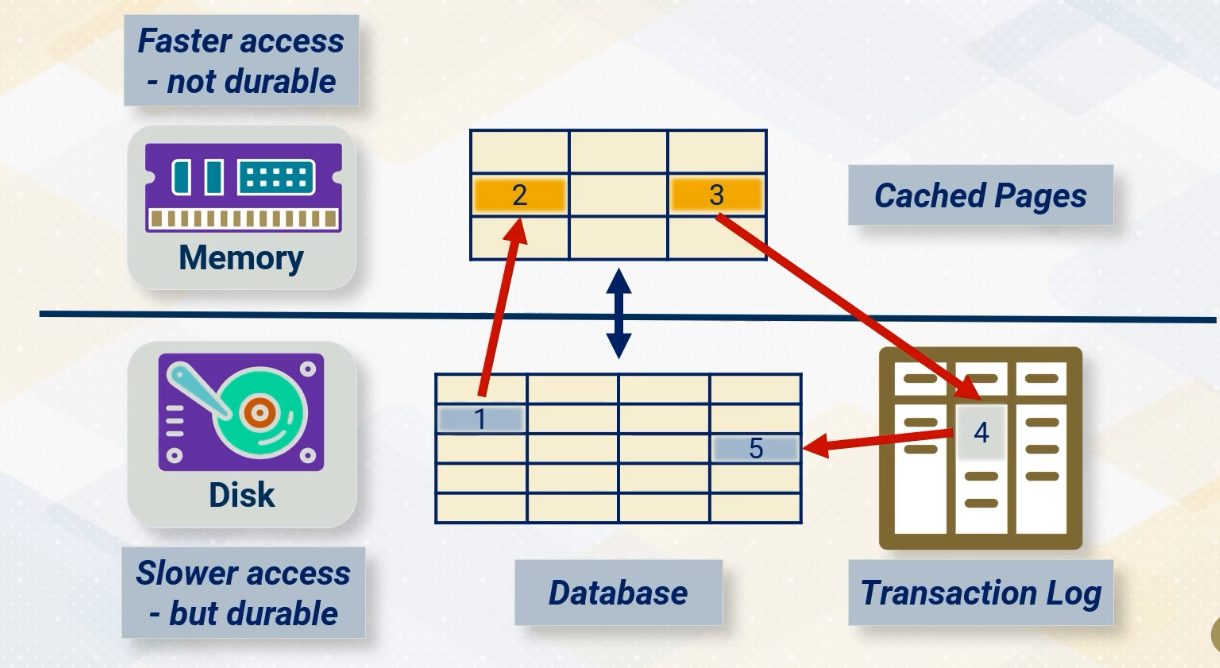
The diagram above shows a row being read into memory, changes are made, these are saved to the transaction log before being applied to the underlying data.
# Usability
Using SQL to access the data reduces the need to write custom code for each query. This allows for the separation between the logical and physical storage of the data.
# Normal form
Codd introduces normalisation to handle relations that contain nonsimple domains — columns whose values are themselves relations (nested or repeating groups) rather than atomic values.
A relation whose domains are all simple (atomic, non-decomposable values) can be represented as a flat two-dimensional array. When a relation has nonsimple domains, this flat representation breaks down and a more complex storage structure is needed. Eliminating nonsimple domains is therefore desirable both for storage and for enabling a universal data sublanguage.
The normalisation procedure works as follows:
- Start with the top-level relation and take its primary key.
- Expand each immediately subordinate (nested) relation by inserting this primary key into it.
- Remove the nonsimple domains from the parent relation.
- Repeat down the tree until all relations are flat.
An unnormalised employee relation might have a nested jobhistory domain (which itself contains a nested salaryhistory), and a children domain:
employee (man#, name, birthdate, jobhistory, children)
jobhistory (jobdate, title, salaryhistory)
salaryhistory (salarydate, salary)
children (childname, birthyear)
After normalisation, each relation is flat with the parent primary key propagated down:
employee' (man#, name, birthdate)
jobhistory' (man#, jobdate, title)
salaryhistory' (man#, jobdate, salarydate, salary)
children' (man#, childname, birthyear)
Normal form is a prerequisite for the universal data sublanguage Codd proposes, and is the foundation of the 1NF/2NF/3NF normal forms covered later in the course. It also removes dependence on pointers, hash addressing schemes, and index ordering lists — making the representation portable between systems.
# Relational operations
Operators function over tables (or sets of relations/tuples). There are standardised operations which we will use in this course, described below in terms of generic relational algebra rather than any specific SQL dialect.
SELECT ($\pi$): Selects specific columns from a table, removing duplicate rows from the result so the output is a valid relation. Formally $\pi_L(R)$ where $L$ is the list of column indices to keep.
WHERE ($\sigma$): Filters the rows of a table based on some specific conditions.
GROUP BY ($\gamma$): Groups the rows of a table based on some specific column values.
AGG (aggregation) ($\gamma_{agg}$): Aggregates values defined by a GROUP BY clause - common operations include SUM, COUNT, MIN, MAX, and AVG.
JOIN ($\bowtie$): Links two tables together based on a common key. Formally the natural join $R * S = \{(a, b, c) : R(a, b) \wedge S(b, c)\}$ — combines on a shared domain. Two relations are joinable if such a combining relation exists.
COMPOSITION ($R \cdot S$): A derived operation — join two relations then project away the shared joining column: $R \cdot S = \pi_{1s}(R * S)$.
RESTRICTION ($R_{[L|M]}S$): Produces the maximal subset $R'$ of $R$ such that specified columns of $R'$ match the corresponding columns of $S$ — a generalisation of filtering by matching against another relation.
# Relational algebra
Relational algebra allows us to combine the above operations in a way to create more complex queries. This is the theoretical underpinning of operations on relational databases.
Below is an example relational algebra query for getting the total ’likes’ in a table.
*SORT* ($\tau$) TotalLikes DESC
  ($\pi$ PostID, TotalLikes, UsersWhoLiked
    ($\gamma$ COUNT(*) -> TotalLikes,
      GROUP_CONCAT(..) -> UsersWhoLiked
    ($\sigma$ ReactionType = 'like'
      (Interactions) $\bowtie$ Users)
    )
  )
# SQL
SQL is a language that implements this relational algebra. Whilst SQL is referred to as a language it has many ‘dialects’ depending on the application that is implementing it — the core syntax is the same but dialects can add additional syntax or make different choices for what is considered a table identifier or string.
Below is an example SQL query for getting the total ’likes’ in a table.
SELECT Interactions.PostID, COUNT(*) AS TotalLikes,
  GROUP_CONCAT(DISTINCT Users.UserID || '-' || Users.Username)
FROM Interactions
JOIN Users ON Interactions.UserID = Users.UserID
WHERE Interactions.ReactionType = 'like'
GROUP BY Interactions.PostID
ORDER BY TotalLikes DESC
LIMIT 1;
This query gets the most liked post by id and shows the users who liked it. The output might look something like:
PostID, TotalLikes, UsersWhoLiked
1002, 3, 3-alex;4-bella;5-charlie
# Transactions
Above we have discussed transactions but here we go into detail about what their general properties are. At a high level a transaction is a way to safely apply multiple changes to the database as a single unit. This is important when the database must not be left in an invalid intermediate state — for example in banking applications or medical records. To achieve this we say transactions are ACID compliant, we go through each property in more detail below.
# Atomicity
A transaction is atomic if either all the changes happen or none of them do. Exactly the same idea as an atomic operation at the operating system level.
# Consistency
Consistency guarantees that a transaction can only bring the database from one valid state to another valid state — all integrity constraints, foreign key relations, and business rules must hold after every transaction. If a transaction would violate any constraint it is rejected and rolled back, leaving the database unchanged. For example, a bank transfer that would leave an account with a negative balance (violating a non-negative balance constraint) would be rejected in its entirety. This differs from atomicity: atomicity is about whether changes happen at all; consistency is about whether the resulting state is valid.
Codd’s original paper defines consistency at a different level: a database state is consistent if it satisfies a declared set of constraint statements $Z$ about the named relations — i.e. all the inter-relation invariants the database administrator has declared hold true at that instant. This is a database-wide, instantaneous property, whereas ACID consistency is a per-transaction guarantee. The two are complementary: Codd’s consistency describes what the invariants are; ACID consistency describes how transactions preserve them.
# Isolation
Isolation guarantees that concurrently executing transactions do not interfere with one another — each transaction sees the database as if it were running alone. For example, suppose two transactions run concurrently: T1 increments a balance by 100 and T2 increments it by 200, both reading an initial balance of 0. Without isolation, both transactions may read the same starting value of 0 and each write their own result independently, leaving the final balance at either 100 or 200 rather than the correct 300. With isolation, the transactions are effectively serialised so that one reads the result of the other, guaranteeing the balance ends at 300.
# Durability
Durability guarantees that once a transaction is successfully committed, that change is permanently stored — it will survive crashes, power failures, or restarts. For example, if a bank commits a transaction that reduces a user’s balance by $500, durability ensures that even if the system crashes immediately afterwards that deduction is not lost when the database recovers.
This is implemented using the WAL (Write-Ahead Log) — a log of all changes that is written to durable storage before the transaction is finalised. On recovery after a crash, the database replays the WAL to restore all committed transactions. Note that a crash before commit simply means the transaction is discarded — the WAL only guarantees committed changes are not lost.